CNC vs Traditional Woodworking
Computer-controlled precision vs hand-guided craft — two radically different approaches that increasingly complement each other in modern workshops
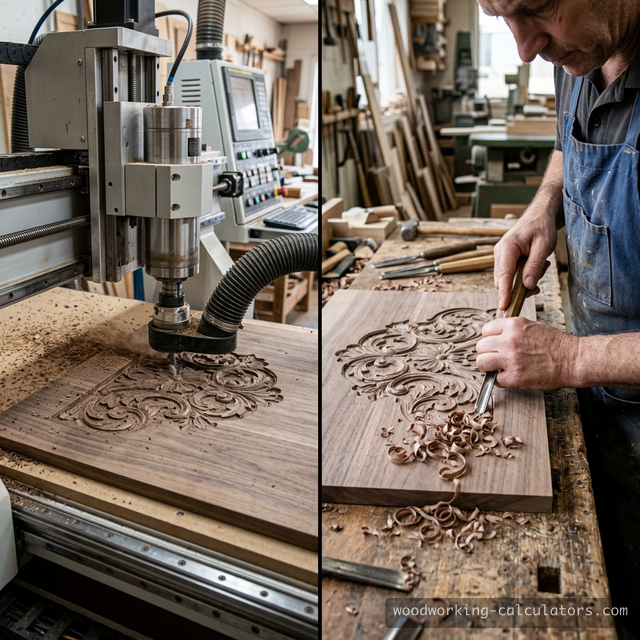
Quick Comparison
| Factor | CNC Router | Traditional Woodworking |
|---|---|---|
| Repeatability | Perfect — 1,000 identical parts, zero variation | Limited — each piece has subtle differences |
| Complexity | Unlimited 2.5D/3D shapes from files | Limited by skill and tool geometry |
| Setup Time | High — design, CAM, toolpath, workholding | Low — mark and cut |
| Run Time | Automated — machine cuts while you work elsewhere | Manual — you are the machine |
| Startup Cost | $2,000-50,000+ (machine + software + tooling) | $500-5,000 (tools + bench) |
| Space | Large footprint + enclosure + dust extraction | Flexible — bench-based |
| Skill Type | Digital: CAD/CAM, feeds & speeds, toolpath strategy | Physical: hand-eye, sharpening, joinery |
| Material Waste | Can be high — nesting optimization critical | Generally lower — humans adapt in real-time |
| Perceived Value | "Made by machine" — lower perceived craft value | "Handmade" — higher perceived craft value |
What Each Does Best
CNC Excels At:
- Complex 2D shapes: Intricate cutouts, lettering, inlays, and interlocking parts that would take hours by hand are produced in minutes. A sign with 200 carved letters takes 10 minutes on CNC and 20 hours by hand.
- 3D carving: Relief carvings, sculptural forms, and complex topographic surfaces that are impossible to produce by hand at scale. CNC-carved guitar tops, furniture legs, and architectural details.
- Batch production: 100 identical parts produced overnight. Nest them on a 4×8 sheet and the machine cuts while you sleep. Each part is dimensionally identical — no fitting required.
- Sheet good optimization: Nesting software maximizes yield from expensive plywood sheets. A CNC can achieve 85-90% material utilization vs 70-80% with manual cutting.
- Digital design integration: Designs created in CAD can go from screen to finished part with no interpretation loss. Client approval of 3D renders translates directly to production.
Traditional Woodworking Excels At:
- One-off custom pieces: When making one table, the setup time for CNC exceeds the time to just build it by hand. Traditional excels when every piece is different.
- Fine joinery: Dovetails, mortise-and-tenon, and hand-cut joints carry craftsmanship value that CNC cannot replicate. The slight imperfections signal quality and human skill.
- Material response: A human woodworker reads the grain, adjusts cutting direction, works around defects, and makes micro-decisions that no CNC program anticipates. Grain tearout, knot avoidance, and figure placement are human skills.
- Edge and surface finishing: Hand-planed surfaces, chamfered edges, and sculpted curves have a quality that CNC surfaces (which require sanding to remove tool marks) cannot match.
- Low overhead: No software licenses ($200-2,000/year for professional CAM), no machine maintenance ($200-500/year), no bit replacements ($50-200/job for specialty tooling).
Cost & Setup
| CNC Tier | Machine Cost | Software | Annual Operating | Capability |
|---|---|---|---|---|
| Hobby (Shapeoko, X-Carve) | $2,000-4,000 | $0-500 | $200-400 | Small parts, signs, inlays |
| Prosumer (Avid, Onefinity) | $5,000-15,000 | $500-2,000 | $400-800 | Full 4x8 sheets, furniture parts |
| Professional (Laguna, Biesse) | $20,000-100,000+ | $2,000-5,000 | $1,000-3,000 | Production, ATC, enclosed |
Traditional shop: $500-5,000 for a complete hand tool and power tool setup. $100-300/year in consumables (sandpaper, blades, sharpening). No software licenses. No machine maintenance beyond blade sharpening.
Skills Required
The skills are completely different — mastering one does not help with the other:
- CNC skills: CAD modeling (Fusion 360, SketchUp), CAM toolpath generation, feeds and speeds calculation, workholding design, bit selection, and troubleshooting (chatter, burn marks, material deflection). The learning curve is 3-6 months for basic competency, 1-2 years for advanced work. Most of the skill is digital, not physical.
- Traditional skills: Plane tuning, chisel sharpening, layout and measurement, joinery cutting, grain reading, and material "feel." The learning curve is 1-2 years for basic competency, 5-10+ years for mastery. The skill is physical and intuitive — built through thousands of hours of practice.
Output Quality
Both approaches produce excellent results, but in different ways:
- CNC precision: ±0.005 inch repeatability. Every part identical. Complex geometry executed flawlessly. But: tool marks require sanding, inside corners have a radius (tool diameter), and the surface lacks the character of hand-finished work.
- Traditional precision: A skilled craftsman achieves ±0.01 inch on joinery — slightly less precise than CNC, but joints are custom-fitted (not just cut to tolerance). Surfaces are hand-finished (planed, scraped, or sanded by touch) and have character.
- Market perception: "Handmade" commands a 30-50% price premium over "CNC-made" for equivalent pieces. Customers value the human labor signal. Many professionals use CNC for hidden components and hand-finish everything visible — getting the best of both worlds.
Verdict
The question is not "which is better" but "which problems am I solving?"
- Choose CNC if: you are making batches, need complex shapes, run a production business, or want to integrate digital design workflows.
- Choose traditional if: you are making one-off pieces, value the craft process, have limited space/budget, or are selling "handmade" as a value proposition.
- Choose both if: you run a professional shop — CNC for parts, traditional for assembly and finishing. This is the direction the industry is moving.
The most successful modern woodworking businesses use CNC for stock preparation, complex cutting, and repetitive parts, then hand-fit joints, hand-plane surfaces, and hand-apply finishes. The machine does the heavy lifting; the craftsman adds the value.
Recommended Calculators
Project Cost Calculator
Compare total project costs: CNC material + programming time + bit wear vs traditional labor time + tooling. The economics shift based on batch size.
Plywood Sheet Calculator
CNC excels at cutting sheet goods. Calculate sheet requirements and nesting efficiency for machine vs manual cutting.
Board Feet Calculator
Traditional solid wood projects are calculated in BF. CNC projects often use sheet goods — different math entirely.
Wood Waste Calculator
CNC waste comes from nesting gaps and toolpath kerf. Traditional waste comes from defects and cutting errors. Calculate for your method.
Workshop Layout Calculator
A 4x8 CNC router needs at minimum a 12x12 foot zone with clearance. Plan your shop layout around the machine footprint.