Custom Furniture Project Planning
Plan any custom furniture piece from species selection through final pricing — every design decision and material calculation paired with the right tool
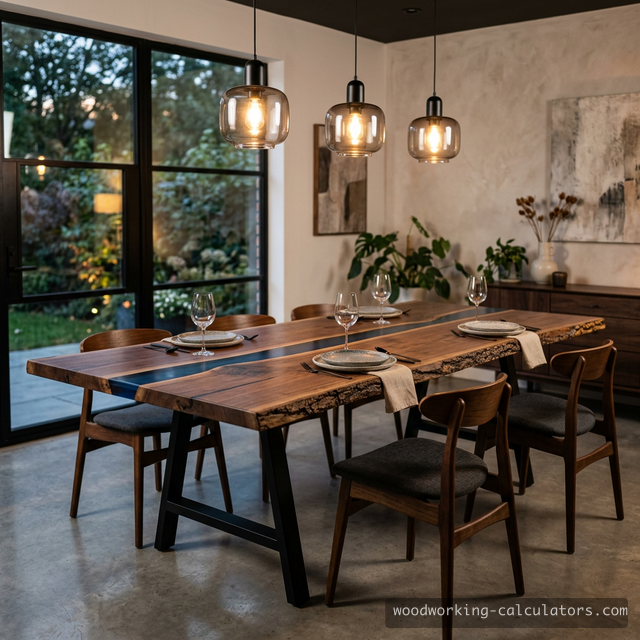
Planning Workflow
Follow these steps with the right calculators at each stage
Select & Estimate Material
Choose your wood species based on the balance of appearance, workability, and cost your project demands. Walnut runs $8-14 per board foot, cherry $6-10, maple $5-8, and oak $4-7. Calculate total board footage with at least 20-25% overage — you will lose material to defects, grain matching, and cutting waste. A dining table typically needs 30-40 BF for the top, plus another 10-15 BF for legs, aprons, and stretchers. Check density to predict weight: a 6-foot walnut table top at 3/4 inch thick weighs approximately 35-45 lbs before finish.
Design Joinery
Select joints based on the structural demands and visual style of each connection. Mortise and tenon joints are the backbone of frame construction — set mortise depth to 2/3 of stock thickness and width to 1/3 of stock width. For dovetails on drawers or case pieces, use a 1:6 pin-to-tail ratio in softwoods and 1:8 in hardwoods. Dado and groove joints at 1/3 stock thickness are ideal for shelving and case dividers. Our calculators generate exact dimensions and saw settings for each joint type.
Plan Assembly & Fasteners
Glue-ups are the most stressful part of furniture making — plan them in advance. Calculate total glue needed based on joint surface area: expect roughly 6-8 square inches of coverage per ounce of PVA glue. A typical table requires 8-12 oz total. Plan your glue-up sequence: which joints get assembled first, how many clamps you need, and what your open time is (15-20 minutes for standard yellow glue, 30+ for extended formulas). For supplemental fasteners, count pocket screws, dowels, or figure-eight fasteners needed.
Calculate Finishing
Furniture finishing has enormous surface area when you count all faces: a dining table plus 6 chairs might have 80-100 square feet of surface to finish. Budget for 3 coats of topcoat on all surfaces, with sanding between coats at 320 grit. If staining, calculate stain coverage separately — end grain absorbs 3-4x more stain than face grain. Track sandpaper needs across grit progressions: 120 for initial surfacing, 150 after raising the grain, 180 and 220 for final smoothing, 320 between finish coats.
Set Your Price
If you are selling this piece, pricing is critical to sustainability. Start with material costs (calculated in steps 1-4), then add labor hours at your true shop rate (including overhead — most custom furniture makers need $35-75/hour to be viable). A dining table typically takes 40-80 hours depending on complexity. Add overhead allocation (shop rent, utilities, insurance, tool depreciation), then apply your target profit margin: 30-50% is standard for custom furniture. Our pricing calculator breaks all of this down so you present a confident, defensible price.
All Related Calculators
Board Feet Calculator
Calculate lumber volume for custom furniture with precise dimensions. Input rough lumber sizes and get board foot totals with cost estimates per species.
Dovetail Joint Calculator
Calculate pin and tail dimensions, spacing, and angles for through and half-blind dovetails. Set pin-to-tail ratios and get exact marking and cutting measurements.
Mortise & Tenon Calculator
Calculate optimal mortise and tenon dimensions based on stock thickness. Includes shoulder offsets, tenon length, and rule-of-thirds proportioning.
Wood Expansion Calculator
Predict seasonal wood movement across table tops, panel glue-ups, and case sides. Calculate expansion gaps for breadboard ends and frame-and-panel construction.
Wood Finish Calculator
Calculate finish material for all furniture surfaces with multi-coat coverage rates. Accounts for differences between open-pore and closed-pore wood species.
Furniture Pricing Calculator
Comprehensive pricing tool: material costs + labor hours + overhead allocation + profit margin. Generates a professional price breakdown you can share with clients.
Glue Consumption Calculator
Calculate wood glue quantities based on joint types and surface areas. Includes coverage rates for PVA, polyurethane, and epoxy adhesives.
Lumber Cost Calculator
Estimate total material costs with species-specific pricing, waste factors, and surfacing surcharges. Compare cost scenarios across different wood species.
Need More Tools?
Browse our complete collection of 55+ professional woodworking calculators