Dust Collection System Guide
Protect your lungs and keep your shop clean — how to size, design, and install a dust collection system that actually works
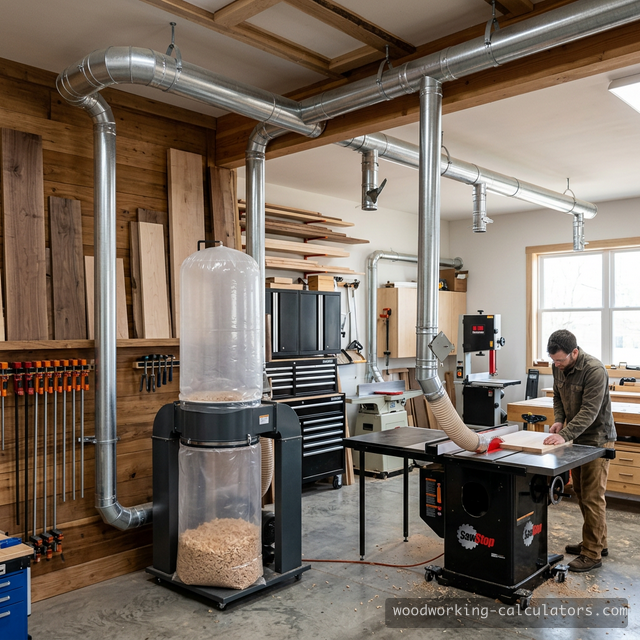
Why Dust Collection Matters
Wood dust is classified as a Group 1 carcinogen (IARC). Long-term exposure without protection leads to nasal cancer, respiratory disease, and chronic asthma. A good dust collection system is not a convenience — it is health infrastructure.
Beyond health, dust causes practical problems: it coats tools and finishes (ruining wet finish surfaces), builds up on electrical connections (fire hazard), and makes cleanup take longer than building. The cleanest shops are the ones with the best collection systems.
CFM Requirements by Tool
CFM (cubic feet per minute) measures air volume flow. Each tool needs a minimum airflow at the dust port to capture chips and fine dust effectively. These are the figures based on port diameter and testing:
| Tool | Port Size | Required CFM | Notes |
|---|---|---|---|
| Table Saw | 4" | 350-400 | Cabinet saw needs more than contractor saw |
| Planer (12-13") | 4" | 400-500 | Highest CFM demand in most shops |
| Jointer (6-8") | 4" | 350-400 | Similar to table saw |
| Bandsaw | 4" | 350 | Lower guard needs separate 2.5" connection |
| Router Table | 2.5-4" | 195-350 | Enclosed cabinet style captures more |
| Drum Sander | 4" | 350-400 | Fine dust — needs good filtration |
| Miter Saw | 2.5" | 195 | Dust hood design affects capture rate |
| Floor Sweep | 4" | 100-150 | For sweeping dust off the floor |
Key principle: In a one-person shop, you only run one major tool at a time. So your collector only needs to satisfy the most demanding tool (usually the planer at 400-500 CFM) — not the sum of all tools.
Collector Types
Single-Stage Collector (Most Common)
All debris passes through the impeller (fan). Simple, affordable ($200-400 for 1-1.5 HP). Limitation: fine dust passes through the impeller and gets trapped in the filter, which needs frequent cleaning. Always add a separator (cyclone or Thien baffle) before a single-stage collector — it removes 90%+ of debris before it reaches the impeller, dramatically extending filter life.
Two-Stage Collector (Cyclone)
Air enters a cyclone cone that spins debris into a collection drum before clean air reaches the impeller and filter. Better filtration, less filter maintenance, quieter operation. Cost: $800-2,000 for 1.5-3 HP units. The professional choice for dedicated shops.
Shop Vac (Supplemental)
Not a replacement for a dust collector but essential for sanding dust, hand-held tool connections, and cleanup. A shop vac delivers high pressure (suction) but low CFM — opposite of what chip-producing tools need. Use for: orbital sanders, routers (handheld), track saws, final cleanup.
Ductwork Design
Your collector's rated CFM drops dramatically through ductwork. Every bend, length of pipe, and reduction eats into your available airflow through static pressure losses:
- Straight 4" pipe: ~1 inch water gauge (inWG) loss per 10 feet
- 90° elbow: equivalent to ~5 feet of straight pipe
- 45° wye junction: equivalent to ~3 feet of straight pipe
- Flexible hose: 2-3x the loss of smooth rigid pipe per foot
Practical rule: a 1.5 HP collector rated at 800 CFM at the inlet will deliver approximately 400-600 CFM through 20 feet of 4-inch ductwork with 2-3 elbows. Use 4-inch main trunk lines and reduce to smaller ports only at the tool connection. Never use 2.5-inch duct as a main line — it chokes airflow.
Blast gates: Install a blast gate at each tool drop and close all gates except the tool you are using. This concentrates all available CFM at the active tool instead of splitting it.
Filtration — The Part Most People Get Wrong
A dust collector without proper filtration is worse than no collector at all — it collects coarse chips but blows fine respirable dust (<10 microns) back into the shop air.
- 30-micron bags (standard): Nearly useless for health protection. They catch chips but pass all dangerous fine dust. Replace immediately.
- 1-micron filter bags: The minimum acceptable filtration. Catches 89%+ of particles >1 micron. Upgrade cost: $50-100. Mandatory upgrade for all collectors.
- 0.5-micron cartridge filters: The best option for canister-style collectors. Catches 99%+ of harmful particles. $80-150. Available for most major collector brands.
Ambient air filtration (AAF): Even with a good collector and filter, some fine dust escapes. A ceiling-mounted air filtration unit ($150-300) continuously scrubs the air. Size it for 3-4 air changes per hour: a 20x20 shop (400 sq ft × 8 ft ceiling = 3,200 cubic feet) needs a unit rated for 800-1,000 CFM. Run it during work and for 30 minutes after your last cut.
Recommended Calculators
Dust Collection Calculator
Calculate CFM needs, static pressure losses through your ductwork, and recommended collector HP for your specific shop layout.
Workshop Layout Calculator
Plan ductwork runs and blast gate locations by positioning tools to minimize total duct length and elbows.
Workshop Lighting Calculator
Plan lighting placement so you can see dust accumulation in corners and on machines — early detection prevents buildup.
Project Cost Calculator
Budget your entire dust collection system: collector, separator, ductwork, blast gates, hose, and ambient filter unit.