Garage Workshop Conversion
Turn your garage into a real workshop without losing car parking — mobile tool stations, smart electrical upgrades, and dust management designed for shared garage spaces
Planning Workflow
Follow these steps with the right calculators at each stage
Assess Your Garage Space
Start with honest measurements. A standard 2-car garage is roughly 20x20 feet (400 sq ft); a single-car is about 12x22 feet (264 sq ft). Now subtract the non-negotiable zones: garage door tracks extend 12-18 inches on each side, the garage door opener motor hangs at about 7 feet (limiting overhead storage height), water heater and furnace take their footprint plus 30 inches of required clearance, and the electrical panel needs a 36-inch clear zone in front. If you are keeping one car, that eats a 10x20 foot zone — leaving you with the other half (200 sq ft) for the shop. Map all fixed obstructions on paper before imagining any tool placement.
Plan Shared vs Dedicated Zones
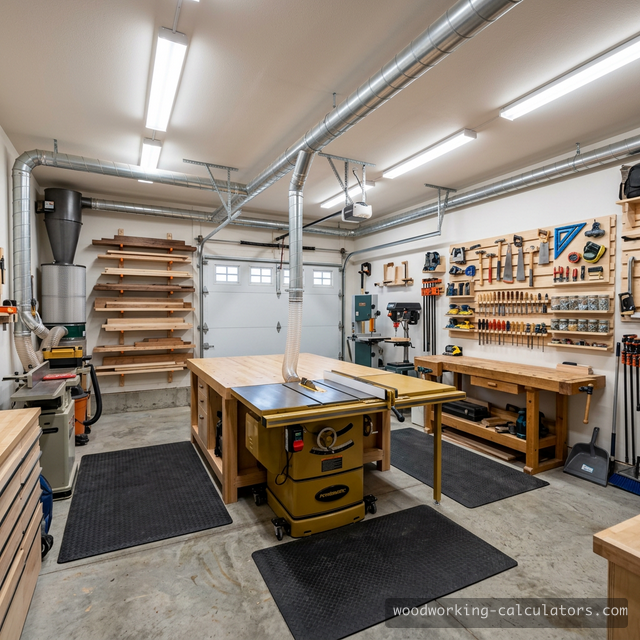
The key to a garage workshop is separating permanent stations from mobile ones. Permanent zones (back wall): your workbench, wood storage rack, hand tool cabinet, and dust collector. These never move, so build them solidly. Mobile zones (center floor area shared with car): table saw, planer, bandsaw, and drill press on locking caster bases (about $30-60 each). When you need to park, roll the tools against the walls. Size your mobile bases so everything fits along the perimeter walls and the car fits with 18 inches of clearance on each side. Install a French cleat wall system on the back wall — it holds everything from clamp racks to tool holders and can be reconfigured in seconds.
Upgrade Electrical Service
This is the most critical (and often most expensive) conversion step. Most garages have a single 15A or 20A circuit serving the overhead light and one outlet — totally inadequate for a workshop. You need at minimum: (1) two 20A circuits for tool stations, positioned so your table saw and planer/jointer are on separate circuits; (2) one 20A circuit dedicated to dust collection; (3) one 15A circuit for lighting (LED shop lights draw very little). Cost reality: an electrician typically charges $200-400 per new circuit run from your main panel to the garage. Budget $800-1,600 for a proper 4-circuit upgrade. If your main panel is full, a subpanel in the garage ($500-800 installed) gives you room to grow. Always pull permits — unpermitted electrical work can void your homeowner's insurance.
Install Dust Collection
Garages present unique dust collection challenges. Concrete floors mean dust does not sink in — it sits on the surface and gets tracked through the house (the #1 complaint from spouses). Open ceiling rafters become dust shelves. And if your car lives in the same space, fine wood dust settles on the paint. Solutions: (1) a tool-connected dust collector (1-1.5 HP for a one-person shop) for your table saw, planer, and jointer — the big dust producers; (2) a ceiling-mounted air filtration unit ($150-300) that runs continuously to capture fine airborne particles under 5 microns; (3) a quality shop vac with a cyclone separator for sanding dust and cleanup. Run flexible hose to tools rather than hard ductwork in a garage — you need the flexibility to move tools for car parking.
Manage Climate & Flooring
Garages are brutal environments for woodworking: extreme temperature swings, humidity fluctuations, and hard concrete floors. Address each: (1) Temperature: insulate the garage door with foam board panels ($50-100, adds R-8) and seal the perimeter with weatherstripping. For winter, a 30,000 BTU propane forced-air heater ($150-300) warms a 2-car garage in 15 minutes. For summer, a box fan or portable evaporative cooler plus an open door provides sufficient cooling. (2) Humidity: a cheap hygrometer ($10) monitors conditions. Wood stored in an uninsulated garage acclimates to outdoor humidity, which can be 60-80% — keep lumber stickered and off the floor on a rack. (3) Flooring: don't paint or coat the concrete — it gets slippery with sawdust. Instead, stand on an anti-fatigue mat ($25-40) at the workbench. Seal cracks where sawdust accumulates with concrete caulk.
All Related Calculators
Workshop Layout Calculator
Plan your garage shop layout with tool footprints, clearance zones, and car parking dimensions. Visualize how tools fit when parked vs in working position.
Workshop Lighting Calculator
Calculate LED shop lights for your garage workshop. Most garages have one 60W bulb — you need 8-12 LED fixtures for proper working light.
Dust Collection Calculator
Size your dust collector for a garage workshop — includes CFM calculations, duct sizing, and recommendations for shared-space configurations.
Shelf Span Calculator
Design heavy-duty garage wall shelving for lumber storage, hardware bins, and tool cases. Garage shelves need to hold far more weight than indoor shelves.
Moisture Content Calculator
Monitor lumber moisture content in your garage environment. Uninsulated garages cycle through 40-80% humidity seasonally — track MC before starting any project.
Wood Expansion Calculator
Calculate expected wood movement in a garage environment. Wider temperature and humidity swings mean more dramatic expansion and contraction.
Board Feet Calculator
Estimate lumber for shop furniture: workbench, outfeed table, tool stands, and storage projects that make your garage workshop functional.
Project Total Cost Calculator
Budget your full garage conversion: electrical upgrades, dust collection, lighting, insulation, and shop furniture — see the total before committing.
Need More Tools?
Browse our complete collection of 55+ professional woodworking calculators