Hand Tools vs Power Tools
Two philosophies, one craft — understand the real trade-offs in speed, precision, noise, space, and quality to build the workshop that fits your life
Quick Comparison
| Factor | Hand Tools | Power Tools |
|---|---|---|
| Speed | Slow — a hand-planed surface takes 5-15 min | Fast — power planer does it in 30 seconds |
| Precision | Extreme — controlled by feel and sight | Consistent — controlled by fences and jigs |
| Noise | Silent (under 70 dB) | Loud (85-110 dB, hearing protection required) |
| Dust | Shavings (larger, settle quickly) | Fine dust (airborne, health hazard) |
| Space | A bench and a wall cabinet | 200+ sq ft for major machines + clearance |
| Startup Cost | $200-500 (quality set) | $500-3,000+ (basic shop) |
| Skill Curve | Steep — months to master planing | Moderate — safe setup takes practice |
| Safety | Cuts and gouges (minor injuries) | Kickback, amputations (severe injuries possible) |
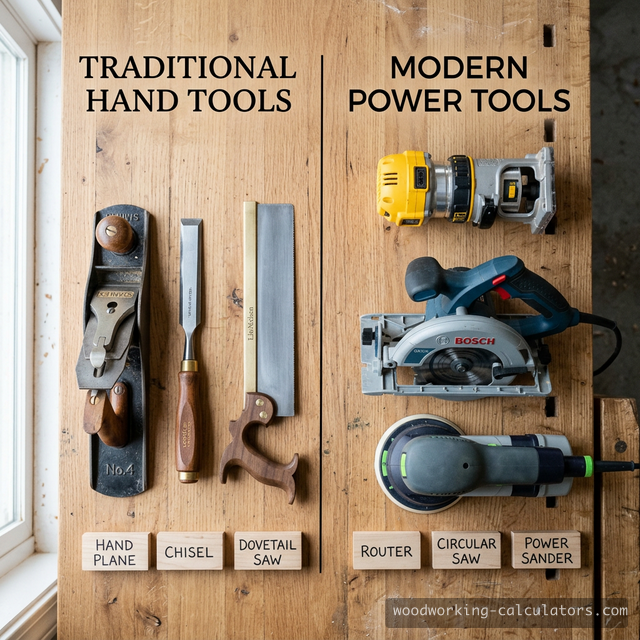
Speed vs Precision
Power tools are undeniably faster for dimensioning lumber. A power planer surfaces a board in one pass (30 seconds); a hand plane takes 5-15 minutes for the same result. A table saw rips a board in 10 seconds; a handsaw takes 2-5 minutes. For production work or projects requiring large volumes of milled lumber, power tools are essential.
However: Hand tools are often faster for joinery setup. Cutting a single mortise by hand (chop, pare, done in 10 minutes) is faster than setting up a router jig, adjusting depth stops, making test cuts, and routing the mortise (15-20 minutes of setup for 30 seconds of cutting). Hand tools win when setup time exceeds cutting time — which is true for most one-off joinery.
For precision, hand tools set the ceiling. A skilled woodworker hand-fits a joint to tolerances tighter than any machine — you literally see and feel the fit as you pare to the line. Power tools deliver repeatability (every joint identical) but not the same custom fit. For dovetails, hand-cut joints fit better; for 50 identical box joints, the table saw jig wins.
Space & Budget
This is often the deciding factor, not preference:
- Apartment or spare room: Hand tools win by default. A workbench, a wall cabinet of tools, and a chair. No electrical requirements, no dust collection, no noise complaints. Total space: 30-50 sq ft.
- Single-car garage or basement: A hybrid approach works. Benchtop power tools (planer, drill press) plus hand tools for joinery. 100-200 sq ft.
- Dedicated workshop: Full power tool setup. Table saw, planer, jointer, bandsaw, router table, dust collection. 300+ sq ft ideal.
Budget reality: A quality hand tool setup (planes, chisels, saws, sharpening) costs $200-500 and lasts a lifetime. A basic power tool shop (table saw, planer, router, sanders, dust collection) costs $1,500-3,000 and requires periodic replacement ($200-500/year in maintenance and consumables). Hand tools are essentially a one-time investment with zero consumable costs beyond sharpening stones.
Safety & Noise
The safety difference is dramatic:
- Hand tool injuries: Cuts from chisels and gouges from slipped planes. Painful but almost never life-altering. First-aid treatable. Risk managed by keeping tools sharp (dull tools slip) and proper body positioning.
- Power tool injuries: Table saw kickback can break ribs or sever fingers. Router bit contact removes flesh instantly. Lathe catches can fracture bones. These are emergency-room injuries that can permanently change your life. Risk managed by guards, technique, and absolute focus.
Noise: Hand tools are silent. You can work at midnight in an apartment without disturbing anyone. Power tools require hearing protection (93-110 dB) and are incompatible with shared living spaces, children napping, or noise-sensitive neighborhoods. This is a lifestyle factor that many woodworkers underestimate until they live with it.
Result Quality
A common misconception is that power tools make better work. The truth is more nuanced:
- Surface quality: A hand-planed surface is superior to a machine-planed surface. Hand planing leaves a slightly scalloped surface that catches light beautifully, while a power planer leaves tiny ridges (snipe marks, cutter marks) that need sanding. The best professional furniture makers hand-plane final surfaces regardless of how they dimension stock.
- Joint quality: Hand-cut dovetails have subtle irregularities that signal craftsmanship — each tail slightly different. Machine-cut dovetails are geometrically perfect but visually "dead." Both are structurally excellent; the aesthetic preference is personal.
- Overall design: Power tools enable complex shapes (curved cuts, profile routing) efficiently. Hand tools can achieve the same but take significantly longer. For curved work, a bandsaw plus spokeshave is far faster than carving by hand alone.
Verdict
The best woodworkers use both. The false dichotomy of "hand tool woodworker" vs "power tool woodworker" is a social media construct, not a workshop reality.
The practical approach: use power tools for dimensioning (milling rough lumber to thickness, width, and length) and hand tools for joinery and surface finishing (fitting joints, planing surfaces, chamfering edges). This plays to each technology's strengths:
- Power tools are faster and more consistent at repetitive, heavy-stock-removal operations.
- Hand tools are more precise, quieter, and produce better surfaces for fitting and finishing work.
If budget or space forces a choice, start with hand tools. You can build anything with hand tools — it just takes longer. You cannot build everything with power tools alone — you still need chisels, planes, and scrapers for fitting and finishing.
Recommended Calculators
Project Cost Calculator
Compare total project costs with each approach. Hand tool projects cost less in equipment but more in time.
Workshop Layout Calculator
Plan your shop for power tools (clearance zones), hand tools (bench-centric), or a hybrid layout.
Wood Finish Calculator
Both approaches need finishing. Hand-planed surfaces need less sanding prep, potentially saving finish material.
Board Feet Calculator
Calculate lumber regardless of tooling approach. Hand tool users buy closer-to-final-dimension stock to reduce labor.