Hardwood vs Softwood
Two fundamentally different types of wood — understand the real differences in hardness, workability, cost, and durability to choose the right one for every project
Quick Comparison
| Property | Hardwoods | Softwoods |
|---|---|---|
| Source | Deciduous trees (oaks, maples, walnut) | Coniferous trees (pine, cedar, fir) |
| Janka Range | 950-3,680 lbf | 350-660 lbf |
| Cost | $4-20+/BF | $2-7/BF |
| Availability | Hardwood dealers, specialty yards | Home centers, any lumber yard |
| Sold As | Rough-sawn, priced by BF | Dimensional (S4S), priced by LF or piece |
| Grain | Tight, varied, often figured | Coarser, more uniform, knottier |
| Finish | Natural finish, stain, oil | Often painted; clear finish on cedar/fir |
| Best For | Furniture, cabinets, flooring | Framing, painted projects, outdoor, beginner |
Hardness & Durability
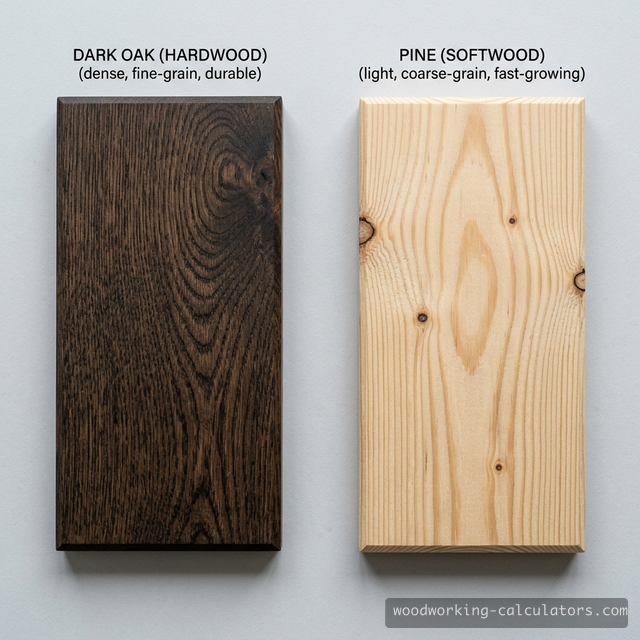
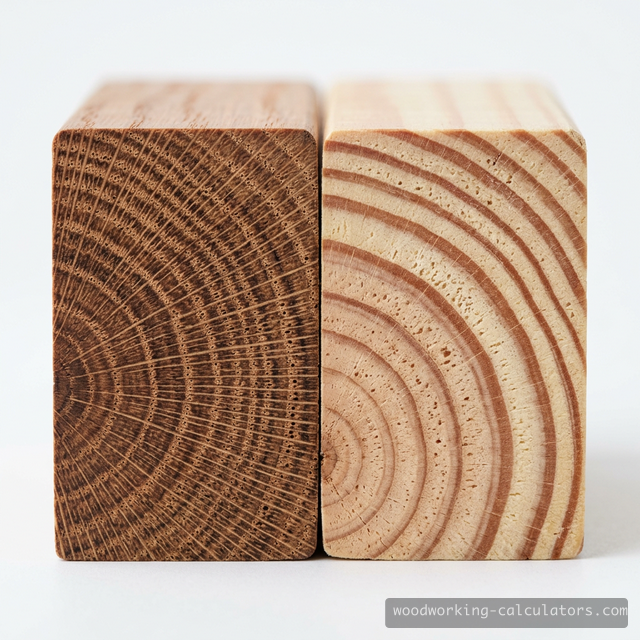
The terms "hardwood" and "softwood" are botanical classifications, not hardness ratings — but they correlate strongly. Hardwoods come from angiosperms (flowering, leaf-shedding trees) and softwoods from gymnosperms (cone-bearing, needle trees).
In practice, every common hardwood species is harder than every common softwood. The softest widely-used hardwood (cherry, 950 lbf) is still 44% harder than the hardest common softwood (Douglas fir, 660 lbf). This matters for:
- Dent resistance: A dining table in red oak (1,290 lbf) resists daily use; the same table in pine (380 lbf) dents from normal plates and glasses.
- Wear resistance: Hardwood flooring lasts 50-100 years with refinishing; softwood flooring shows wear paths within 5-10 years.
- Joint strength: Hardwood joints hold screws and dowels more securely because the denser fiber structure grips fasteners tighter.
Exception: For outdoor durability (rot resistance), certain softwoods outperform most hardwoods. Western red cedar and redwood resist decay for 15-20+ years untreated, while many hardwoods rot in 3-5 years. White oak is the hardwood exception, with good natural rot resistance.
Workability
Softwoods are significantly easier to work — they cut faster, plane easier, and sand quicker. But "easier" is not always "better":
- Hand tools: Softwood is much easier to plane and chisel. A beginner can produce clean dovetails in pine on the first attempt; the same cuts in oak require more skill and sharper tools.
- Power tools: Both work fine with standard tooling, but hardwoods produce cleaner cuts on a table saw because the denser fibers resist tearout. Softwood tends to tear along the grain when cross-cut poorly.
- Sanding: Softwoods sand faster but are prone to "fuzzing" — loose fibers that raise but do not cut clean. Hardwoods sand to a glass-smooth surface with fine grits.
- Finishing: Here softwood is harder. Pine absorbs stain unevenly (blotching) because of density variation between growth rings. Hardwoods take stain more uniformly. For clear-coat softwood, a pre-stain conditioner helps but does not fully solve blotching.
Cost Analysis
Softwood costs 50-80% less than hardwood for the same volume. But the comparison is not quite that simple:
| Factor | Hardwood | Softwood |
|---|---|---|
| Raw material cost | $4-14/BF (domestic) to $20+/BF (exotic) | $2-5/BF ($3-8/LF for dimensional) |
| Surfacing needed | Yes — rough-sawn needs planer/jointer (~$0-1/BF if self-surfaced) | No — sold S4S (surfaced four sides) |
| Waste factor | 15-25% (defects, sapwood, ends) | 5-15% (fewer defects in select grades) |
| Effective cost | $5-18/BF usable wood | $2-6/BF usable wood |
| Tool wear | Blades dull faster, more resharpening | Blades last 2-3x longer |
Bottom line: A hardwood dining table costs $300-800 in materials; the same table in premium pine or fir costs $80-200. The gap is real, but hardwood furniture has resale value and longevity that justifies the premium for pieces you will keep.
Best Projects by Wood Type
Use Hardwood When:
- The piece will see daily physical use (tables, chairs, desks, floors)
- You want a natural, clear finish that showcases the wood
- Longevity matters — furniture you will keep for decades or pass down
- The project demands fine joinery (dovetails, mortise-and-tenon)
- The piece has resale value or is a commission/gift
Use Softwood When:
- The project will be painted (pine takes paint beautifully)
- Budget is the primary constraint
- You are a beginner learning joinery and techniques
- The project is outdoor (cedar, redwood for rot resistance)
- The project is structural or utilitarian (shop furniture, jigs, shelving)
- You want a rustic, farmhouse, or Scandinavian aesthetic
Verdict
There is no universal "better" — there is only "better for this project." Most serious woodworkers use both regularly:
- Hardwood for furniture and visible work — the durability, grain beauty, and finishing properties justify the cost for pieces that matter.
- Softwood for practice, painted projects, outdoor builds, and shop furniture — the lower cost and easier workability make it the practical choice when aesthetics are secondary.
If you are just starting out, build your first 3-5 projects in pine or poplar. You will learn joinery, tool setup, and finishing without the anxiety of ruining expensive stock. Then graduate to hardwoods when your skills match the material's demands.
Recommended Calculators
Wood Density Calculator
Compare Janka hardness and density between species. Visualize the hardwood vs softwood gap with real numbers.
Lumber Cost Calculator
Compare material costs for the same project in hardwood vs softwood. Quantity × species price = total budget difference.
Board Feet Calculator
Calculate BF for hardwood and LF for softwood dimensional lumber. Different measurement standards for different wood types.
Wood Expansion Calculator
Compare seasonal movement between hardwood and softwood species. Pine moves less than oak — relevant for panel design.
Wood Finish Calculator
Calculate finish for each type — softwood's open grain absorbs more stain; hardwood needs fewer coats for coverage.
Wood Waste Calculator
Hardwood has higher waste from defects (15-25%) vs softwood (5-15%). Factor this into your material order.