Joinery Selection Guide
The right joint makes furniture last generations — the wrong one fails in years. Compare every major joint type by strength, difficulty, and when to use it
Joint Strength Ranking
Not all joints are created equal. Here's how common joints compare in shear strength (resistance to being pulled apart) based on testing with PVA yellow glue in hardwood:
| Joint Type | Relative Strength | Skill Level | Tools Needed |
|---|---|---|---|
| Mortise & Tenon | ⭐⭐⭐⭐⭐ Strongest | Intermediate | Drill, chisel (or router) |
| Dovetail (through) | ⭐⭐⭐⭐⭐ Strongest | Advanced | Dovetail saw, chisel |
| Box Joint (finger) | ⭐⭐⭐⭐ Very Strong | Intermediate | Table saw + jig |
| Dowel Joint | ⭐⭐⭐ Strong | Beginner | Drill, dowel jig |
| Biscuit Joint | ⭐⭐ Moderate | Beginner | Biscuit joiner |
| Pocket Screw | ⭐⭐ Moderate | Beginner | Pocket hole jig |
| Butt Joint (glued) | ⭐ Weakest | Beginner | Clamps only |
Traditional Joints
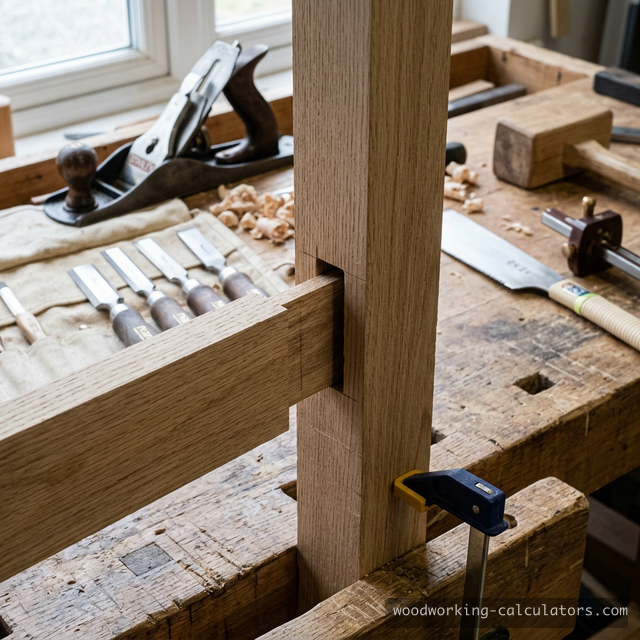
Mortise & Tenon
The king of woodworking joints. A rectangular peg (tenon) fits into a rectangular hole (mortise). When properly fitted and glued, this joint is stronger than the surrounding wood — the wood will break before the joint fails. Standard proportions: tenon thickness = 1/3 the rail thickness, tenon length = 4-5x the tenon thickness. For a 3/4-inch rail, the tenon is 1/4 inch thick and 1 to 1-1/4 inches long. Use for: table aprons to legs, door frames, chair joints, face frame construction.
Through Dovetail
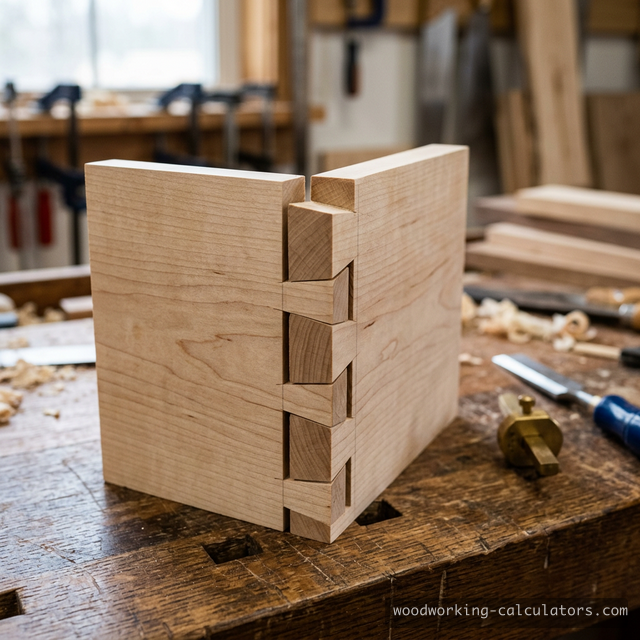
The hallmark of fine craftsmanship. Interlocking trapezoidal pins and tails create enormous mechanical strength plus massive long-grain glue surface. The angled geometry resists being pulled apart in one direction — that's why drawers use dovetails (the tails in the drawer front resist the pull of opening). Standard slope: 1:8 for hardwoods, 1:6 for softwoods. Use for: drawer boxes, jewelry boxes, tool chests, case construction.
Half-Blind Dovetail
Visible from one side only — the joint of choice for drawer fronts where you want the front face clean. Same mechanical advantage as through dovetails but more difficult to cut because you cannot saw through to the other side. Use for: drawer fronts, cabinet corners where one face should be clean.
Dado & Rabbet
A dado is a groove cut across the grain; a rabbet is a groove cut at the edge. Neither is strong alone — they provide positive alignment and resist racking when combined with glue or screws. A shelf sitting in a dado will not slide forward under load. Standard depth: 1/3 to 1/2 the board thickness. Use for: shelving in bookcases, cabinet backs, drawer bottoms.
Modern Joints
Pocket Screws
An angled screw driven through a pocket hole in one piece into the adjacent piece. Fast and easy with a pocket hole jig ($30-150). The screw provides clamping force during assembly — no need for clamps. Strength is moderate and relies on screw thread, not glue surface. Joints can loosen over time with seasonal movement. Use for: face frames, quick cabinet assembly, shop jigs, projects where speed matters more than heirloom quality.
Biscuits
Compressed beech wafers inserted into matching slots. Biscuits excel at alignment (keeping boards flush during panel glue-up) but add minimal strength — edge-grain to edge-grain glue joints are already stronger than the wood. Biscuits are essentially alignment aids, not structural joints. Use for: panel glue-up alignment, mitered corner alignment, quick case assembly.
Dowels
Round wooden pins inserted into matched holes in both pieces. Stronger than biscuits because the dowel spans the joint deeper. Critical: hole alignment must be precise (a dowel jig is essential) and dowels must be fluted or spiral-grooved to allow glue and air to escape. Typical size: 3/8-inch dowels for 3/4-inch stock. Use for: edge-to-edge joints, frame joints, shelf supports, mid-range furniture.
Choosing by Project Type
| Project | Primary Joint | Why |
|---|---|---|
| Dining Table | Mortise & Tenon | Handles racking forces and seasonal movement |
| Drawer Boxes | Dovetail or Box Joint | Resists pull force from opening, massive glue area |
| Bookcase Shelves | Dado + Screw | Supports vertical load, prevents forward sliding |
| Cabinet Face Frame | Pocket Screw or M&T | Speed (pocket) vs heirloom quality (M&T) |
| Cutting Board | Edge Glue Only | Long-grain to long-grain glue is stronger than wood |
| Picture Frame | Miter + Spline | Clean corner appearance with mechanical reinforcement |
| Jewelry Box | Half-Blind Dovetail | Clean front face, handmade quality signal |
Glue & Reinforcement
PVA (yellow glue): The default for indoor furniture. Stronger than the wood itself in long-grain joints. Open time: 5-10 minutes. Apply thin, even coat to both surfaces. Squeeze-out indicates sufficient coverage.
Polyurethane (Gorilla Glue): Waterproof, good for outdoor joints. Foams to fill small gaps but has weaker bond strength than PVA in tight joints. Requires moisture to cure — mist one surface lightly.
Epoxy: Gap-filling, waterproof, strongest adhesive for poorly fitting joints. Expensive, messy, and hard to clean up. Use when joints have gaps or with oily tropical species that repel PVA.
Hide glue: Traditional, reversible (can be reheated to disassemble). Preferred by instrument makers and restorers. Long open time in liquid form. Excellent creep resistance.
Recommended Calculators
Dovetail Calculator
Calculate pin and tail dimensions, spacing, and slope angles. Set up your marking gauge and dovetail saw correctly.
Mortise & Tenon Calculator
Calculate mortise depth, tenon thickness, and shoulder dimensions. Follow the 1/3 rule and optimize for maximum glue surface.
Dado & Groove Calculator
Calculate dado width and depth for shelf joinery. Match dado width to your plywood thickness (which is rarely a full 3/4 inch).
Box Joint Calculator
Calculate finger spacing for box joints on the table saw. Even spacing requires precise jig setup.
Glue Calculator
Calculate glue for joint assembly. Mortise-and-tenon joints and dovetails have more surface area than you expect.
Miter Angle Calculator
Calculate miter and spline dimensions for picture frames and polygon boxes. Mitered joints need splines or biscuits for strength.