Lumber Buying Guide
Navigate lumber grades, spot defects, understand board foot pricing, and find the best sources — everything the lumber yard assumes you already know
Hardwood Grading (NHLA System)
The National Hardwood Lumber Association (NHLA) grades hardwood lumber based on the percentage of clear, defect-free wood you can cut from each board. Higher grades mean more usable wood per board but cost significantly more.
| Grade | Min Clear Area | Min Board Size | Price Premium | Best For |
|---|---|---|---|---|
| FAS (First & Seconds) | 83-100% | 6" × 8' | Highest | Wide panels, tabletops, visible surfaces |
| FAS 1 Face | 83%+ one face | 6" × 8' | 10-15% less than FAS | Panels good side up, veneered backs |
| Select | 83%+ one face | 4" × 6' | ~Same as F1F | Narrower projects, trim |
| #1 Common | 66-83% | 3" × 4' | 30-40% less than FAS | Smaller parts, drawers, face frames |
| #2 Common | 50-66% | 3" × 4' | 50-60% less than FAS | Short parts, rustic projects, small items |
Pro tip: #1 Common is often the best value for furniture making. You can cut clear parts from around the defects, and the shorter, narrower boards are perfectly fine for drawer sides, back panels, and frame parts. Buy FAS only for wide tabletop panels and other large, visible components.
Softwood Grading
Softwood uses a completely different grading system based on visual appearance rather than clear-cutting yield:
- C Select / D Select: Nearly clear, suitable for natural finish. Premium price, limited availability.
- #1 / #2 (Construction grade): The most common grade at home centers. Some tight knots, minor defects. Fine for painted projects.
- Stud grade: Structural, not appearance-rated. Heavy knotting, wane, twist acceptable. Not suitable for furniture.
For woodworking projects in softwood (pine, cedar, fir), look for "select" or "premium" boards at the home center — they cost 20-40% more than construction grade but save hours of picking through defective boards.
Common Defects to Watch For
Learning to read defects is the most valuable skill at the lumber yard. Some defects are cosmetic concerns; others are structural deal-breakers.
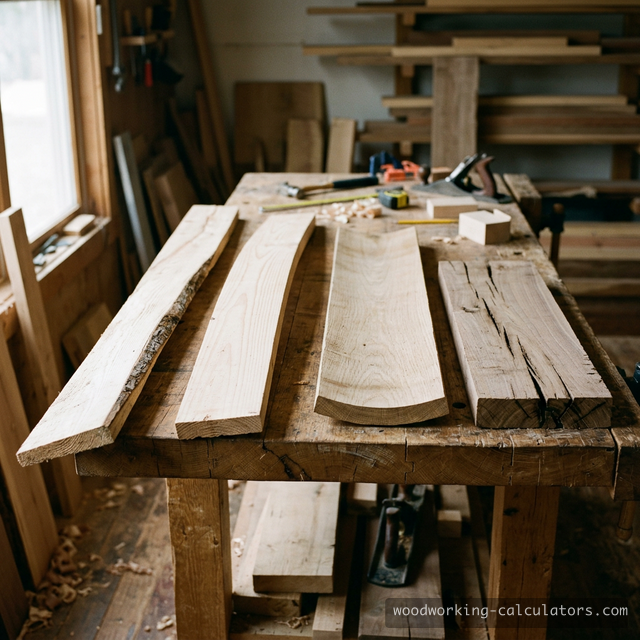
- Twist: Board spirals along its length. Sight down the board like a rifle barrel. Mild twist can be planed out if the board is thick enough; severe twist means the board is useless. Reject if twist exceeds 1/4 turn.
- Bow: Board curves along its length. Lay it on a flat surface — if the gap in the center exceeds 1/4 inch per 4 feet, the bow requires significant planing. Usable if you have thickness to spare.
- Cup: Board curves across its width. Common in flatsawn boards. Can be ripped into narrower strips and re-jointed. Fixable in most cases.
- Checks & Splits: Cracks at the ends from drying stress. Common and expected — plan to cut 2-4 inches off each end. Budget for end loss.
- Knots: Tight knots (firmly attached) are cosmetic; loose knots (dark ring around them) are structural weak points that will fall out. Tight knots OK if not in a joint; reject loose knots.
- Wane: Bark or missing wood at the board edge. Requires ripping to remove. Reduce your usable width calculation.
Pricing & Board Foot Measurement
Hardwood is sold by the board foot (BF): 1 BF = 12" × 12" × 1" = 144 cubic inches. A board that is 6 inches wide, 8 feet long, and 1 inch thick = 4 BF.
Thickness notation: Hardwood thickness is given in quarter-inch increments. 4/4 (four-quarter) = 1 inch rough, which planes down to 13/16 inch. 8/4 = 2 inches rough, planing to 1-3/4 inch. Always account for planing loss — you lose 3/16 to 1/4 inch from each rough thickness.
| Rough Thickness | Notation | After Planing | Typical Use |
|---|---|---|---|
| 1" | 4/4 | ~13/16" | Shelves, panels, drawer parts |
| 1-1/4" | 5/4 | ~1-1/16" | Tabletops, thick panels |
| 1-1/2" | 6/4 | ~1-5/16" | Legs, aprons, thick trim |
| 2" | 8/4 | ~1-3/4" | Bench tops, heavy legs, turning blanks |
Where to Buy
Home Centers (Home Depot, Lowe's)
Pros: Convenient, S4S (surfaced four sides), boards are pre-dimensioned. Cons: Limited species (poplar, red oak, sometimes maple), premium pricing (often 40-60% more per BF than a hardwood dealer), rarely stocked above 4/4 thickness, and quality is hit-or-miss. Best for: small projects, softwoods, plywood.
Hardwood Dealers / Lumber Yards
Pros: Wide species selection, rough-sawn lumber (more wood for your money), thicker stock available, volume discounts. Cons: Requires planing equipment at home, minimum purchase amounts sometimes apply, less convenient locations. Best for: serious furniture projects, ongoing work, buying in bulk. This is where professional woodworkers buy their wood.
Online Lumber Retailers
Pros: Exotic and specialty species, figured wood, convenience. Cons: Cannot inspect boards before purchase, shipping is expensive ($20-80 per order), and prices are 20-50% higher than local dealers. Best for: exotic species, figured wood, small quantities of specialty material.
Recommended Calculators
Board Feet Calculator
Calculate BF from board dimensions. Essential for pricing — hardwood is sold by the board foot, not the linear foot.
Lumber Cost Calculator
Estimate total material cost by species and grade. Compare FAS vs #1 Common pricing for your project.
Wood Waste Calculator
Factor in defect loss, planing waste, and cutting waste. Lower grades have more defects — calculate the true usable yield.
Moisture Content Calculator
Verify lumber MC before buying. Kiln-dried should be 6-8%. Air-dried stock may need further acclimation.
Wood Density Calculator
Know the weight of your lumber order before loading the truck. A cart of 8/4 white oak is surprisingly heavy.
Plywood Sheet Calculator
When solid wood isn't right, calculate plywood needs. Sheet goods are graded differently and sold by the sheet.