Small Space Workshop Planning
You don't need a barn — a functional woodworking shop fits in 100-200 sq ft with the right tool choices, multi-function stations, and smart wall storage
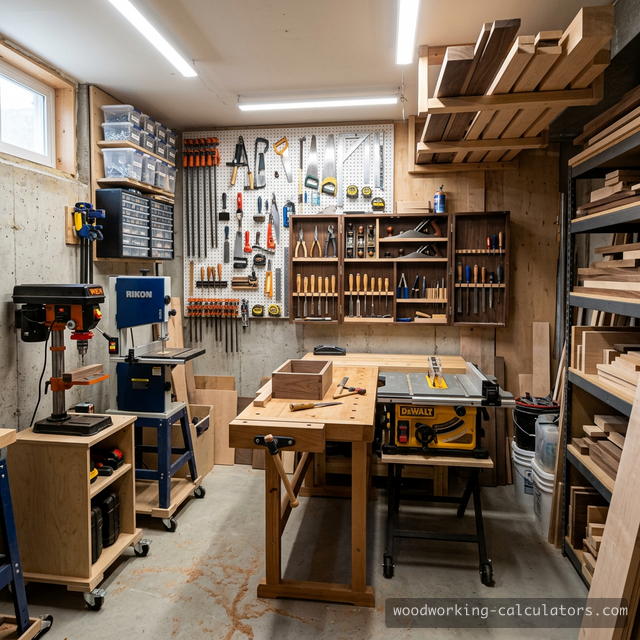
Planning Workflow
Follow these steps with the right calculators at each stage
Prioritize Core Tools for Small Spaces
In a small shop, every tool must earn its floor space. The critical question is not 'what tools do I want?' but 'what tools cover the most operations in the smallest footprint?' Your core four for under 200 sq ft: (1) a job-site table saw or track saw — a job-site saw folds and stores vertically, occupying 2 sq ft when folded vs 15 sq ft for a cabinet saw; (2) a benchtop planer (12-13 inch) at $300-500 that sits on a cart and tucks under the workbench; (3) a handheld router with a compact router table insert — far more versatile than a full table; (4) a random orbit sander and a quality hand saw. Skip the bandsaw, floor drill press, and jointer for now — a hand plane can joint edges, and a jigsaw handles curves.
Design Multi-Function Stations
The secret weapon of small workshops is multi-function furniture. Build a flip-top tool stand: a cart with a rotating top that puts the router table on one side and the benchtop sander on the other — flip it in 10 seconds instead of swapping out tools. Your workbench should have built-in storage underneath: drawers for hand tools, shelves for finish supplies, and a fold-out extension for assembly support. Your outfeed table should also serve as an assembly table, downdraft sanding station, and packaging surface. Build everything at the same height as your table saw (typically 34-36 inches) so any surface can serve as outfeed support. Mobile bases on every piece so you can reconfigure the shop for different operations — ripping long boards, assembling cases, or finishing.
Maximize Wall & Ceiling Storage
In a small shop, walls are your most valuable real estate. A French cleat system across one full wall ($30-50 in plywood) gives you infinite reconfigurable storage: angled cleats on the wall, matching cleats on the back of every tool holder, shelf, and clamp rack. Build custom holders for each tool so they nest tightly — a well-organized French cleat wall holds 100+ hand tools, all visible and accessible. Ceiling storage is the hidden multiplier: install 2x4 supports across ceiling joists for overhead lumber storage (capacity: 200+ lbs per pair when lagged into joists), and hang seldom-used tools from ceiling hooks. Pegboard works for smaller tools and provides cheaper, faster coverage than French cleats for areas behind the workbench. Target: 80% of your tools on walls, 20% on the floor.
Solve Noise & Dust in Shared Buildings
Small spaces in apartments, townhouses, or shared buildings demand noise and dust consciousness. Noise: a planer at 100+ dB is a neighbor complaint waiting to happen. Prefer hand planes for thickness reduction (silent), a track saw over a table saw (10 dB quieter at 85 vs 95 dB), and a sander with a dust port over freehand sanding. Work during reasonable hours and warn neighbors before noisy operations. Dust: in small spaces, dust concentration is dangerous faster — you are breathing recirculated air from a smaller volume. A shop vac connected to every tool is the minimum. Add a $150-250 ceiling air filtration unit sized for your room: a 100 sq ft shop needs a unit rated for at least 400 CFM to cycle the air 3-4 times per hour. Wet mopping after sessions captures what the vacuum misses.
Budget a Compact Setup
The good news: a small shop costs dramatically less to set up than a full workshop. Benchtop tools cost 40-60% less than their floor-standing equivalents: a benchtop planer ($350) vs a floor planer ($800+), a job-site table saw ($300-500) vs a cabinet saw ($1,500-3,000), a router table insert ($100) vs a standalone table ($300+). Infrastructure is cheaper too: fewer lights (3-4 LED fixtures vs 8-12), simpler dust collection (shop vac + cyclone separator for $80-120 vs a $300+ dedicated collector), and less electrical work. A realistic budget: $300-500 for a solid workbench (materials), $200-400 for wall storage systems, $100-200 for lighting, $100-150 for air filtration, and $50-100 for mobile bases. Total infrastructure: $750-1,350 — leaving your tool budget separate.
All Related Calculators
Workshop Layout Calculator
Plan a compact shop layout with tool footprints and clearance zones. See how tools fit in 100-200 sq ft with proper infeed/outfeed paths.
Workbench Calculator
Size a workbench for a small shop: narrower depth (20-24 inches vs 30), matched height to table saw, and built-in storage underneath.
Workshop Lighting Calculator
Calculate LED fixtures for compact spaces. Small shops need fewer fixtures but more precise placement to avoid shadows in tight quarters.
Dust Collection Calculator
Size a dust management strategy for small spaces: shop vac connection, cyclone separator, and air filtration unit rated for your room volume.
Shelf Span Calculator
Design compact wall shelving for heavy workshop loads. French cleat shelves need to hold tool cases, hardware bins, and finish cans.
Board Feet Calculator
Calculate lumber for multi-function shop furniture: flip-top stands, fold-down workbenches, and rolling carts.
Plywood Sheet Calculator
Calculate plywood for French cleat walls, shop cabinets, and flip-top tool stand construction. One sheet of 3/4-inch plywood covers 8 linear feet of French cleat wall.
Project Total Cost Calculator
Budget your small shop setup: workbench, storage systems, lighting, dust management, and mobile bases. Small shops run $750-1,350 in infrastructure.
Need More Tools?
Browse our complete collection of 55+ professional woodworking calculators