Solid Wood vs Plywood
Two materials that serve different purposes — understand when solid wood's beauty shines and when plywood's stability and efficiency make it the smarter choice
Quick Comparison
| Property | Solid Wood | Plywood |
|---|---|---|
| Dimensional Stability | Expands/contracts 1-3% seasonally | Negligible movement (<0.1%) |
| Maximum Width | Limited by board width (4-12" typical) | 48" sheets standard |
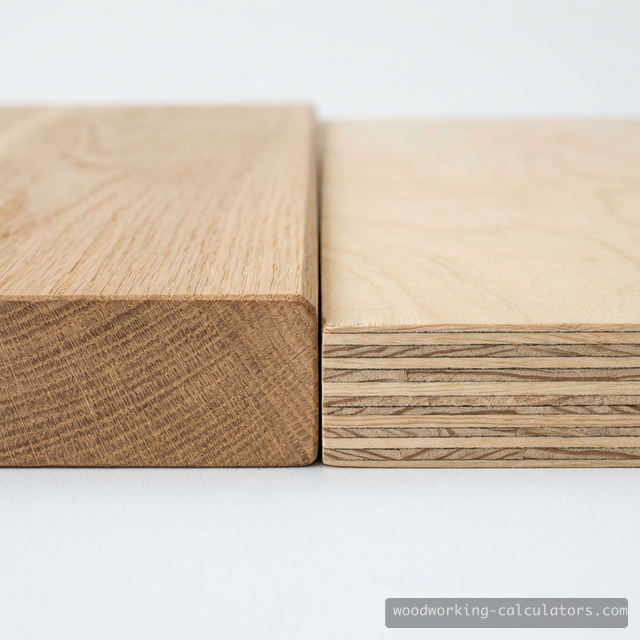
| Edge Appearance | Beautiful — shows grain | Layered plies — needs edge banding |
| Face Appearance | Natural, deep grain, ages beautifully | Veneer face — good but thinner |
| Strength (panel) | Strong along grain, weak across | Equal strength in all directions |
| Weight | Varies by species | Typically lighter than solid hardwood |
| Joinery | Full range — dovetails, M&T, etc. | Dados, screws, dowels (no dovetails) |
| Cost | $4-14/BF (varies by species) | $30-120/sheet ($1.50-5/sq ft) |
Strength & Stability
This is where plywood genuinely outperforms solid wood in certain applications. Plywood's cross-laminated layers cancel out directional wood movement — a 24-inch wide plywood panel stays virtually the same width year-round, while a 24-inch solid wood panel may expand or shrink by 3/16 to 1/4 inch with seasonal humidity changes.
Plywood is also equally strong in both directions (along and across the face), while solid wood is strong along the grain but weak across it. A solid wood shelf in a bookcase deflects based on species and grain direction; a plywood shelf of the same species deflects the same amount regardless of orientation.
However: Solid wood is stronger in pure bending. A 3/4-inch solid maple board has more bending strength than 3/4-inch maple plywood because the cross-grain plies in plywood weaken it compared to continuous long-grain fibers. For structural applications (table aprons, legs, chair parts), solid wood is superior.
Appearance
This is where solid wood wins decisively:
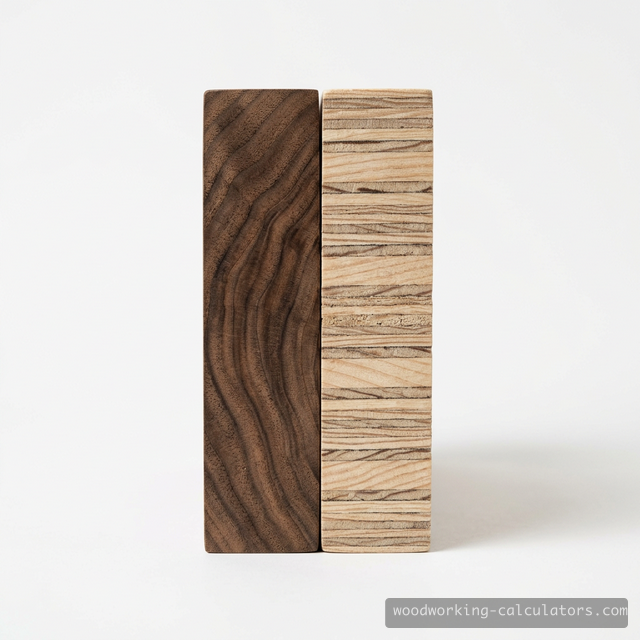
- Edges: Solid wood shows continuous grain on all faces, including edges. Plywood shows layers of plies — acceptable inside cabinets but not for visible edges without edge banding ($0.50-3/LF for iron-on veneer tape).
- Depth: Solid wood has visual depth — grain, figure, and color extend through the full thickness. Plywood's face veneer is 1/28 to 1/42 inch thick. Sanding through the veneer exposes the core — a mistake that ruins a panel.
- Aging: Solid wood develops a patina over decades. Cherry darkens, walnut lightens, and oak develops golden tones. Plywood's thin veneer limits this natural aging process.
- Repairability: Solid wood can be sanded, planed, and refinished indefinitely. Plywood can be lightly sanded once — aggressive sanding burns through the veneer.
Cost & Value
The cost comparison depends on what you are building:
| Application | Solid Wood Cost | Plywood Cost | Better Value |
|---|---|---|---|
| Cabinet box (24"×30"×12") | $60-120 (requires glue-up) | $20-40 (cut from sheet) | Plywood |
| Table top (36"×72") | $150-500 (species dependent) | $40-80 (+ edge banding) | Solid wood (appearance) |
| Bookcase shelves (6 shelves) | $80-200 (wide boards rare) | $30-60 (one sheet) | Plywood |
| Drawer box (set of 6) | $40-100 (dovetailed) | $15-30 (dado&screw) | Depends on quality goal |
Hidden cost of solid wood: You need a planer, jointer, and clamps to mill and glue panels from rough lumber. This tool investment ($500-2,000) is amortized over many projects but significant for beginners. Plywood requires only a saw and straight edge.
When to Use Each
Use Solid Wood For:
- Table tops and desk surfaces — the visual depth and aging-quality of solid wood define fine furniture
- Exposed edges — door stiles and rails, table aprons, frame-and-panel components
- Fine joinery showcase pieces — dovetailed drawers, mortise-and-tenon frames, hand-cut joints
- Turned items and carved elements — plywood cannot be turned or carved
- Pieces intended to last generations — refinishable, repairable, timeless
Use Plywood For:
- Cabinet boxes and carcasses — stability, efficiency, consistent thickness
- Wide panels (over 12") — no glue-up required, no seasonal movement concerns
- Drawer bottoms and cabinet backs — 1/4" plywood is stable and lightweight
- Jigs, fixtures, and shop furniture — fast to build, dimensionally reliable
- Closet and storage systems — cost-effective for large-scale built-ins
Verdict
Most furniture projects use both materials strategically. This is the professional approach: plywood for hidden structural components (cabinet boxes, drawer bottoms, back panels) and solid wood for visible surfaces (tops, doors, face frames, edges). You get plywood's stability and efficiency where no one sees it, and solid wood's beauty and craftmanship where everyone does.
A well-built kitchen uses 10-15 sheets of plywood for cabinet boxes and 40-80 BF of hardwood for doors and face frames. Neither material alone would produce as good a result as both together.
Recommended Calculators
Plywood Sheet Calculator
Calculate how many sheets you need and how to cut them efficiently. Minimize waste from 4x8 sheets with smart layout.
Board Feet Calculator
Calculate solid wood needs in board feet. Compare the BF cost against equivalent plywood sheet costs for your project.
Wood Expansion Calculator
Calculate seasonal movement for solid wood panels. This is the key reason to choose plywood for wide panels in cabinets and built-ins.
Shelf Span Calculator
Compare shelf deflection in solid wood vs plywood. Both sag under load — know the maximum unsupported span for each.
Lumber Cost Calculator
Price your solid wood components. Compare against plywood pricing to make informed material decisions for each part.
Panel Glue-Up Calculator
If choosing solid wood for wide panels, calculate clamp spacing and glue coverage for a strong, flat assembly.