Trim & Molding Installation Guide
From measuring rooms to the final coat of finish — every step of trim installation paired with the right calculator, because perfect miter joints separate pros from amateurs
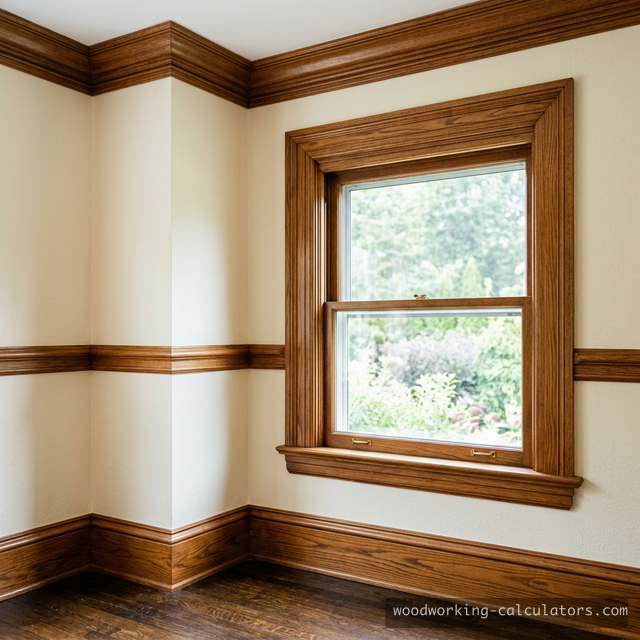
Planning Workflow
Follow these steps with the right calculators at each stage
Measure Linear Footage Room-by-Room
Walk each room with a tape measure and notepad, measuring wall-by-wall for every trim profile you are installing. A typical 12x14 foot room has 52 linear feet of perimeter — subtract door widths (about 3 feet each) for baseboard, and note which walls get crown molding. For casing, measure each door opening (two sides + top = about 17 LF per standard door) and each window opening (all four sides = about 14-18 LF per window). Keep separate tallies for each profile type. Add 10-15% waste to every total — trim cuts produce short offcuts that rarely get reused.
Calculate All Miter & Bevel Angles
This is where most trim projects fail or succeed. Baseboard and chair rail are straightforward — just miter angles for inside and outside corners. But crown molding requires compound angles: both a miter AND a bevel setting that depend on the crown's spring angle. The most common spring angles are 38/52 (most stock profiles) and 45/45 (some specialty crowns). For a 38/52 crown at a standard 90-degree inside corner, you need a miter of 31.6 degrees and a bevel of 33.9 degrees. In renovation work, corners are rarely exactly 90 degrees — measure each one with a digital angle finder and recalculate. Our calculator handles all of this instantly.
Estimate Materials & Waste
Convert your linear footage totals to board count. Standard trim stock comes in 8, 10, 12, and 16-foot lengths. The key to minimizing waste is matching stock lengths to your wall lengths — do not just buy all 16-foot pieces and cut them down. For example, a 10-foot wall needs a 10 or 12-foot piece; buy a 16-footer and you waste 6 feet. Calculate material cost by species and profile: paint-grade MDF baseboard runs $0.70-1.50/LF, primed finger-joint pine costs $1.50-3.00/LF, and solid clear-grade oak baseboard costs $3.00-6.00/LF. For a whole house, the species choice can mean a difference of $500-2,000.
Plan Your Fastener Strategy
Different trim profiles need different fasteners — this is not a one-size-fits-all decision. Use 18-gauge brad nails (1 to 1-1/2 inch) for door and window casing — they hold well and leave tiny holes that nearly disappear with putty. Baseboard needs more holding power: 16-gauge finish nails (2 to 2-1/2 inch) driven into studs every 16 inches, plus one at the top and bottom of each stud location. Crown molding is the most demanding — use 15-gauge angled finish nails (2-1/2 inch) driven into both the wall plate and ceiling joists. Calculate total nails: a room with 52 LF of baseboard at 16 inches on-center needs about 80 nails.
Calculate Finish Coverage
Trim finishing is trickier than flat surface finishing because profiled moldings have significantly more surface area than their nominal width suggests. A 3-1/2 inch baseboard with a decorative profile has roughly 30-50% more paintable surface area than a flat board of the same width. Account for this when calculating primer, paint, or stain quantities — a gallon of primer typically covers 300-400 sq ft on flat surfaces but only 200-280 sq ft on detailed profiles. If staining hardwood trim, end grain absorbs 3-4x more stain — seal end cuts with a washcoat of thinned shellac first. Budget for 2 coats of primer and 2 coats of paint on paint-grade trim, or 1 coat of stain plus 3 coats of topcoat on stain-grade.
All Related Calculators
Moulding Linear Feet Calculator
Calculate total linear footage room-by-room for baseboard, crown, chair rail, and casing with separate waste factors for each profile type.
Crown Molding Calculator
Calculate compound miter and bevel angles for crown molding at any corner angle and spring angle. Supports inside corners, outside corners, and cathedral ceiling transitions.
Miter Angle Calculator
Calculate precise miter saw settings for any corner angle — standard 90-degree, non-standard renovation angles, and polygon joints for bay windows.
Lumber Cost Calculator
Estimate total trim material costs with species and profile-specific pricing. Compare paint-grade MDF vs finger-joint pine vs solid hardwood options.
Screw & Nail Calculator
Calculate fastener quantities by trim type: 18-gauge brads for casing, 16-gauge finish nails for baseboard, 15-gauge for crown. Includes stud-spacing calculations.
Wood Finish Calculator
Calculate finish material for profiled trim surfaces. Accounts for the 30-50% additional surface area that detailed profiles create compared to flat stock.
Wood Waste Calculator
Estimate trim waste based on stock lengths, wall lengths, and cut patterns. Plan stock length purchases to minimize short offcuts.
Wood Stain Coverage Calculator
Estimate stain quantities for hardwood trim with coverage rates adjusted for wood species, profile complexity, and end-grain absorption.
Need More Tools?
Browse our complete collection of 55+ professional woodworking calculators