Understanding Wood Movement
Why wood expands and contracts with the seasons, how much your project will move, and how to design so it stays beautiful for decades instead of splitting apart
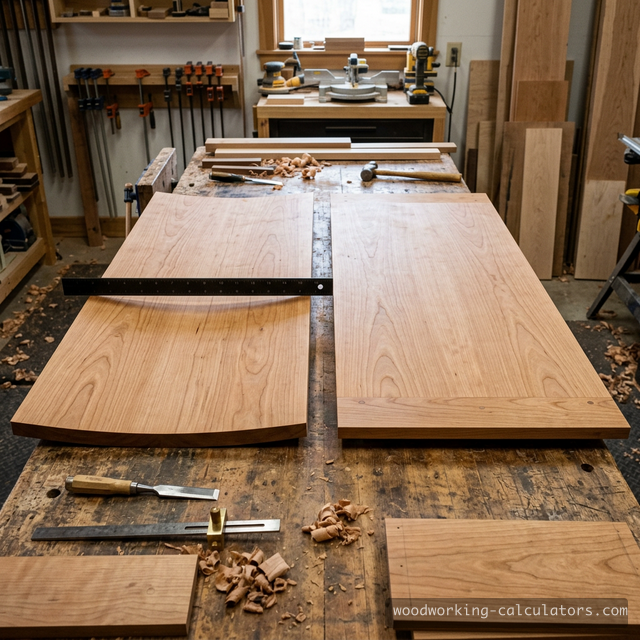
Why Wood Moves
Wood is hygroscopic — it absorbs and releases moisture from the surrounding air. As ambient humidity rises, wood absorbs moisture and expands. As humidity drops, wood releases moisture and shrinks. This cycle never stops, even in finished furniture that is decades old.
The key concept is equilibrium moisture content (EMC) — the point where wood's internal moisture matches the environment. In most heated homes, EMC ranges from 6-10% MC in winter (dry, heated air) to 10-14% MC in summer (humid air). Wood constantly chases this equilibrium, expanding and contracting as it does.
Critical fact: wood moves almost entirely across the grain (width and thickness), NOT along the grain (length). A 12-inch wide tabletop panel might expand 3/16 inch seasonally, but a 6-foot table will not get measurably longer. This directional movement is the single most important concept for furniture design.
How Much Does Wood Move?
The amount of movement depends on three factors: species, grain orientation, and moisture content change.
Grain Orientation Matters Enormously
Flatsawn boards (the most common cut) move roughly twice as much as quartersawn boards of the same species. For a 12-inch wide red oak panel experiencing a 4% MC change:
- Flatsawn: approximately 1/4 inch total movement (1/8 inch expansion + 1/8 inch contraction)
- Quartersawn: approximately 1/8 inch total movement
- Along the grain (length): essentially zero (0.1% or less)
Movement Formula
The basic calculation: Width × Dimensional Change Coefficient × MC Change = Total Movement. Each species has published tangential (flatsawn) and radial (quartersawn) coefficients. Our wood expansion calculator handles this math automatically — just enter your width, species, and expected MC range.
Movement by Species
| Species | Tangential % | Radial % | T/R Ratio | Stability Rating |
|---|---|---|---|---|
| Teak | 4.0% | 2.2% | 1.8 | ⭐⭐⭐⭐⭐ Excellent |
| Mahogany | 4.1% | 2.9% | 1.4 | ⭐⭐⭐⭐ Very Good |
| Walnut | 5.5% | 3.8% | 1.5 | ⭐⭐⭐⭐ Very Good |
| Cherry | 7.1% | 3.7% | 1.9 | ⭐⭐⭐ Good |
| Hard Maple | 9.9% | 4.8% | 2.1 | ⭐⭐ Moderate |
| Red Oak | 8.6% | 4.4% | 2.0 | ⭐⭐ Moderate |
| White Pine | 6.1% | 2.1% | 2.9 | ⭐⭐⭐ Good |
| Beech | 11.9% | 5.5% | 2.2 | ⭐ Poor |
T/R Ratio significance: A lower T/R ratio means the wood moves more evenly in both directions, resulting in less cupping and warping. Mahogany's low 1.4 ratio is one reason it has been prized for centuries in fine furniture — it moves, but it moves predictably and evenly.
Designing for Movement
Designing for wood movement means allowing the wood to move without fighting rigid attachments. Here are the essential techniques:
Table Tops: Never Glue to the Apron
Use tabletop fasteners (Z-clips, figure-8 fasteners, or shop-made buttons) that allow the top to expand and contract across the apron. A 36-inch wide dining table in red oak can move nearly 1/4-inch seasonally — if the top is screwed or glued rigidly to the apron, it will crack down the center.
Frame-and-Panel Construction
This is the classic solution: a rigid frame (which barely moves because its narrow members have minimal cross-grain width) surrounds a floating panel that sits in grooves and moves freely. The panel must NOT be glued into the grooves. Leave 1/8 inch of space on each side for expansion. This is why centuries-old frame-and-panel doors still look perfect.
Breadboard Ends
Breadboard ends keep a tabletop flat but must allow cross-grain movement. The center tongue-and-groove joint is glued; the outer holes are elongated slots so the top can expand outward from center. Drill the mortise holes for the outer dowels as slots, not round holes.
Drawer Construction
Size drawer bottoms for maximum seasonal width and let them float in grooves with 1/16 to 1/8 inch of clearance all around. A plywood bottom largely avoids this problem — plywood moves negligibly because the cross-laminated layers cancel out directional movement.
Common Mistakes
- Gluing cross-grain joints. Attaching a breadboard end with full-width glue prevents movement and guarantees a crack or split within a year. Only glue the center 2-3 inches.
- Mixing grain orientations. A tabletop with some boards flatsawn and some quartersawn will move unevenly, creating a ridge or valley at the glue line.
- Ignoring MC at assembly. Building furniture with wood at 12% MC in the summer means it will shrink when winter drops it to 7% MC. Acclimate lumber in your shop for 1-2 weeks and verify MC before cutting.
- Using MDF and solid wood together incorrectly. MDF does not move; solid wood does. Attaching a solid wood face to an MDF substrate without allowing movement creates warping and delamination.
- Screwing through wide solid panels without slots. When attaching a wide solid-wood shelf to a frame, use slotted holes in the frame to allow cross-grain movement. Round holes in both pieces = crack in the shelf.
Recommended Calculators
Wood Expansion Calculator
Predict seasonal movement for any width, species, and moisture content range. See exactly how much your tabletop or panel will expand and contract.
Moisture Content Calculator
Convert between moisture content percentages and equilibrium moisture content based on temperature and relative humidity.
Wood Density Calculator
Compare species by density and dimensional change coefficients. Denser species generally move more, with notable exceptions.
Panel Glue-Up Calculator
Plan panel width with movement allowance. Calculate clamp spacing and glue coverage for solid wood panel assemblies.
Dovetail Joint Calculator
Calculate dovetail dimensions that accommodate seasonal movement in drawer construction and casework.
Wood Finish Calculator
Film-forming finishes like polyurethane slow moisture exchange and reduce seasonal movement. Penetrating finishes offer less protection.