Wood Grain Guide
Grain determines how wood looks, moves, and works — understanding grain patterns, figure, and direction separates competent woodworkers from excellent ones
Sawing Methods & Grain Patterns
The way a log is sawn into boards determines the grain pattern you see on the face. The same log produces dramatically different-looking boards depending on the cutting method:
| Cut Method | Grain Pattern | Stability | Cost | Best For |
|---|---|---|---|---|
| Flatsawn (plain sawn) | Cathedral/arched patterns | Most movement, prone to cupping | Lowest (most common) | Wide boards, rustic look |
| Quartersawn | Straight, parallel lines | Very stable, minimal cupping | 20-30% premium | Table tops, fine furniture |
| Riftsawn | Tight, straight, uniform | Most stable | Highest (most waste) | Table legs, high-end panels |
How the Cuts Differ
Flatsawn boards are cut tangent to the growth rings. You see the rings as arching, cathedral-shaped patterns. This is the most efficient sawing method (least waste) and the default at most lumber yards. The wide face of the growth rings means maximum seasonal movement and tendency to cup toward the bark side.
Quartersawn boards are cut with the growth rings running 60-90 degrees to the face. You see tight, straight grain lines and, in some species like white oak, dramatic ray flake figure. Movement is roughly half of flatsawn, and cupping is minimal. The premium price reflects the extra sawing and lower yield.
Riftsawn boards are cut with rings at 30-60 degrees to the face, producing the straightest, most uniform grain. Very little figured pattern, very little movement, very high waste during sawing. Used for table legs (the grain looks consistent from all four sides) and premium millwork.
Grain Pattern Types
- Straight grain: Fibers run parallel to the board's length. Easiest to work — planes and cuts cleanly. The strongest orientation for structural use.
- Interlocked grain: Fibers alternate direction in successive layers (common in mahogany, sapele). Creates a ribbon-stripe figure when quartersawn. Extremely prone to tearout — plane lightly and use a high cutting angle or scraper.
- Spiral grain: Fibers twist spirally around the trunk. The board will warp as it dries. Generally undesirable for furniture but occasionally used as a decorative feature.
- Wavy grain: Fibers undulate in waves. Produces the fiddleback/curly figure. Difficult to plane — use very sharp tools, a high cutting angle (50-55 degrees), or a card scraper.
Figured Wood
Figure refers to distinctive visual patterns caused by unusual grain growth, not to be confused with the species' natural grain pattern:
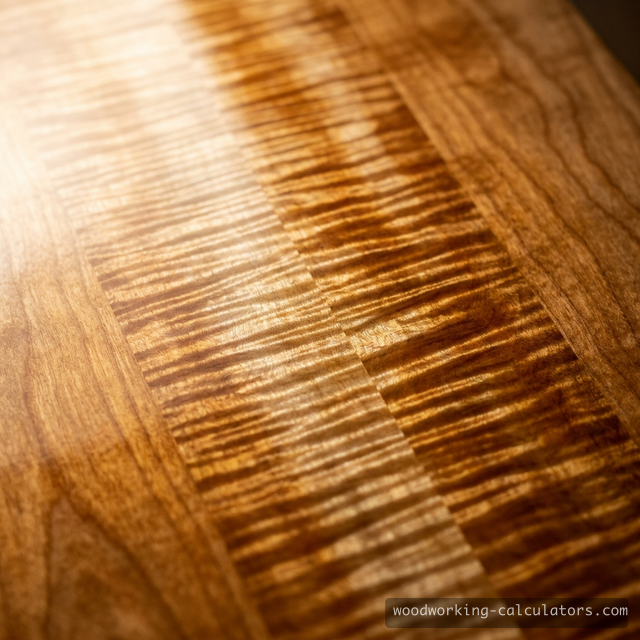
Curly / Fiddleback
Alternating bands of light and dark caused by wavy grain fibers. Named because it is prized for violin backs. Most common in maple and cherry. The 3D shimmer effect (chatoyance) is caused by light reflecting differently off the alternating grain angles. Premium: 2-5x the cost of plain wood. Extremely difficult to plane without tearout.
Bird's Eye
Small, round eye-shaped patterns scattered across the face. Found almost exclusively in hard maple. The cause is debated — likely related to fungal attack or bud scarring. Highly prized for jewelry boxes, decorative panels, and turning. Premium: 3-10x plain maple depending on density of eyes.
Quilted
A pillowy, three-dimensional pattern that appears to billow and bulge. Most common in bigleaf maple and sapele. Creates a stunning holographic visual effect under finish. Used for guitar tops, high-end furniture, and decorative panels.
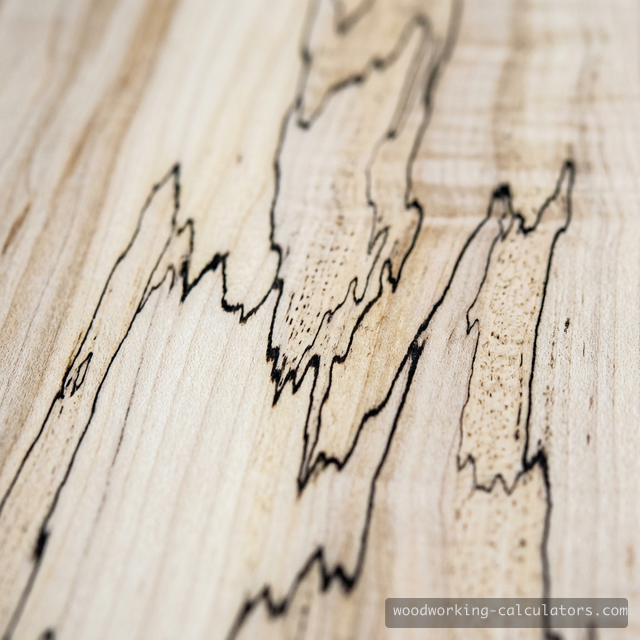
Spalted
Dark zone lines created by fungal growth in the wood. The fungus creates boundaries between colonies, leaving dramatic black lines against lighter wood. Spalting weakens the wood — use it for decorative elements, not structural parts. Work it before it gets too soft (punky). Always wear a respirator when working spalted wood.
Reading Grain Direction
Before planing any surface, you must determine which direction the grain runs — planing against the grain causes tearout (chunks of wood being levered up and torn out instead of shaved cleanly).
- The "stroke the cat" method: Run your hand along the board edge. One direction feels smooth (downhill with the grain); the other catches and feels rough (uphill against the grain). Plane in the smooth direction.
- Look at the edge: On the edge of a board, the grain lines angle like overlapping shingles. Plane in the direction that pushes the blade "under" the shingles (downhill), not into them.
- Reversing grain: Some boards have grain that reverses direction mid-board. You will need to plane from opposite ends, meeting in the middle, or use a high-angle plane (55 degrees or a scraper plane) that works equally well in both directions.
Grain Matching Techniques
When building panels or table tops from multiple boards, grain matching determines whether the result looks intentional or random:
- Book matching: Resawing a board and opening it like a book creates a mirror-image pattern. The most dramatic grain match for tabletops and panels. Caution: one side has reversed grain direction, making planing more challenging.
- Slip matching: Placing consecutive boards side-by-side (not flipped). The grain pattern progresses naturally. Less dramatic than book matching but easier to work because all boards share the same grain direction.
- Random matching: Boards arranged for best color and width balance without grain pattern consideration. Acceptable for painted work or rustic styles. Fastest and most material-efficient.
- Alternating growth rings: Some woodworkers alternate the bark-side up and bark-side down for neighboring boards, theorizing that opposing cup directions cancel out. Evidence is mixed — for stability, quartersawn boards or rift-cut are more reliable than any arrangement trick.
Recommended Calculators
Wood Density Calculator
Grain pattern correlates with density and hardness. Compare species characteristics to predict working properties.
Wood Expansion Calculator
Grain orientation (flatsawn vs quartersawn) determines how much a board moves seasonally. Quartersawn moves half as much.
Panel Glue-Up Calculator
Plan board arrangement and clamp spacing for glued panels. Grain matching decisions are made during panel layout.
Board Feet Calculator
Figured wood and quartersawn stock cost more per BF. Calculate quantities precisely — these special boards should not be wasted.
Wood Finish Calculator
Grain pattern affects finish absorption. Open-grain species need filler; figured wood needs careful application to avoid blotching.
Lumber Cost Calculator
Budget for premium cuts: quartersawn runs 20-30% more than flatsawn; figured stock can be 3-10x the price of plain.