Woodworking Tool Guide
Build your tool collection in the right order — what to buy first, what to skip, and how to maximize your capability on a real budget
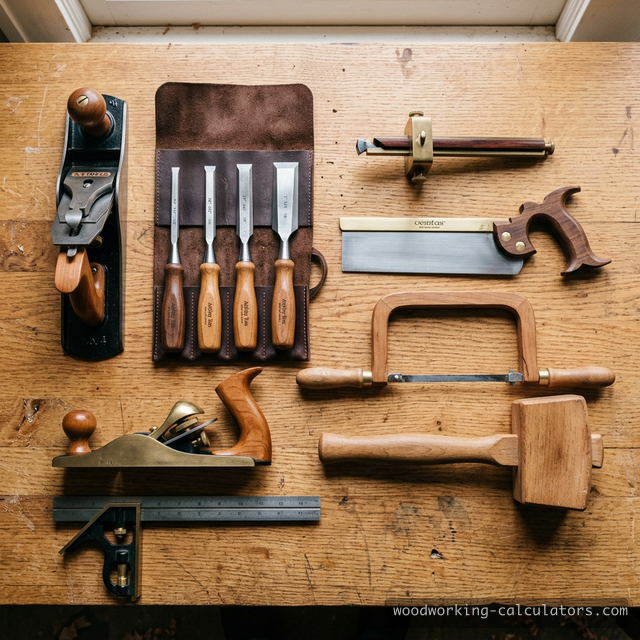
Essential First Tools (Buy These First)
You can build excellent furniture with surprisingly few tools. Do not try to buy everything at once — buy tools as projects demand them. Here are the absolute essentials to start:
| Tool | Budget Option | Quality Option | Why Essential |
|---|---|---|---|
| Combination Square | $12 (Swanson) | $70 (Starrett) | Every mark, every measurement starts here |
| Tape Measure (25') | $10 | $25 (Stanley FatMax) | Rough measurement and layout |
| Chisels (set of 4) | $20 (Narex) | $80 (Stanley Sweetheart) | Joint fitting, mortising, cleanup |
| Mallet | $15 (wooden) | $35 (deadblow) | Drives chisels without damaging handles |
| Block Plane | $35 (Stanley) | $150 (Lie-Nielsen) | End grain, chamfers, fitting – most used hand tool |
| Handsaw (crosscut) | $25 (Japanese pull saw) | $40 (Veritas) | Cuts where machines cannot reach |
| Clamps (4 minimum) | $40 (bar clamps) | $100 (Bessey parallel) | Nothing gets built without clamps |
Total starter budget: $157-500. With these tools plus a workbench surface, you can build boxes, shelves, cutting boards, and small furniture. Every additional tool expands what you can build, but these cover the fundamentals.
Power Tool Priorities
Add power tools in this order, based on which operations they unlock:
Priority 1: Drill/Driver ($70-150)
A cordless drill/driver is the most versatile power tool you will own. Not just for drilling holes — it drives screws, sands with a drum attachment, buffs with a polishing pad, and stirs finish. Buy a quality 20V lithium-ion model with two batteries.
Priority 2: Random Orbit Sander ($50-100)
Hand sanding is tedious and slow. A 5-inch random orbit sander with dust collection reduces finishing prep by 70%. It will not leave swirl marks like a palm sander. Get one with variable speed.
Priority 3: Circular Saw or Track Saw ($60-400)
For breaking down sheet goods and rough-cutting lumber. A circular saw with a straight-edge guide ($60-100) does 80% of what a table saw does. A track saw ($200-400) does 95% with dead-straight cuts and zero tearout. Both are more space-efficient than a table saw.
Priority 4: Table Saw ($300-1,500)
The centerpiece of most shops — essential for ripping, crosscutting with a sled, and joinery operations (dados, rabbets, tenon cheeks). A contractor-style saw ($300-500) handles everything a hobbyist needs. Upgrade to a cabinet saw only when production volume demands it.
Priority 5: Router ($100-200)
The most versatile shaping tool. With different bits, a router cuts dadoes, rabbets, profiles, slot mortises, flush-trims templates, and creates decorative edges. A 2-1/4 HP variable-speed model handles all standard operations.
Hand Tool Essentials
Hand tools complement power tools — they do not replace them (and vice versa). Here are the hand tools worth investing in:
- #5 Jack Plane: Your primary surfacing and edge-jointing tool. Can substitute for a powered jointer in a small shop. A well-tuned jack plane produces a surface smoother than 220-grit sandpaper.
- Marking Gauge: For precise layout lines parallel to an edge. Essential for joinery layout (mortises, tenons, dovetails). A wheel-style cutting gauge ($15-30) is easier to use than a pin-style.
- Dovetail Saw: Fine-toothed backsaw for joinery cuts. Japanese dozuki saws ($25-40) make thinner kerfs and cut faster than Western-style saws.
- Card Scraper: A $5 tool that replaces 80% of your sanding. Scrapes a surface smoother than sandpaper without clogging the grain. Essential for figured wood that tears out under a plane.
- Sharpening system: Dull tools are dangerous tools. Budget at minimum: a combination waterstone (1000/6000 grit, $30-50) and a honing guide ($15-25). Sharpen chisels and plane irons before every session.
Measuring & Marking Tools
Accuracy in woodworking comes from measuring tools, not from expensive machines. These tools cost little but determine the quality of everything you build:
- Combination square: The single most important measuring tool. Use it for layout, checking square, measuring depth, and as a marking gauge. Buy ONE good one — accuracy matters.
- Marking knife: More precise than a pencil for joinery layout. A knife line severs wood fibers, giving your chisel a clean edge to register against. $10-25.
- Digital calipers: For measuring stock thickness, dado width, and hardware dimensions. Accuracy to 0.001 inch. $15-30 for a reliable pair.
- Winding sticks: Two straight sticks used to sight surface twist. Cost: $0 (make them from scrap). Value: priceless for surface preparation.
Smart Buying Strategy
- Buy tools as projects demand them, not in advance. A tool you own but rarely use was a waste of money. Wait until you need a tool for a specific project, then buy it.
- Buy quality for hand tools, budget for power tools. A Narex chisel at $20 is a genuine pleasure to use; a Stanley chisel at $8 fights you. But a $300 job-site table saw and a $1,500 cabinet saw both cut wood — the difference is refinement and convenience, not capability.
- Used tools are often better than new. Older hand planes (Stanley #4 and #5 from the 1940s-60s) are often superior to new budget models. Check garage sales, estate sales, and online marketplaces. Clean, sharpen, and tune — you now have a premium tool for $20-40.
- Avoid tool sales impulse buying. A 30% discount on a tool you do not need is still 70% wasted. Make a wish list and only buy from it.
Recommended Calculators
Project Cost Calculator
Budget a project including tool purchases. Amortize new tool costs across the projects they enable.
Workshop Layout Calculator
Plan where each tool lives in your shop. New tools need floor space — make sure they fit before buying.
Board Feet Calculator
Your most-used calculator — measuring and buying lumber is the first step of every project.
Wood Finish Calculator
Calculate finish supplies alongside your tool budget. Finishing supplies are often forgotten until the project is nearly done.