Workshop Safety Guide
Every woodworker needs to understand dust, noise, blade, and fire risks — the tools are fun, but the safety habits are what keep you working for decades
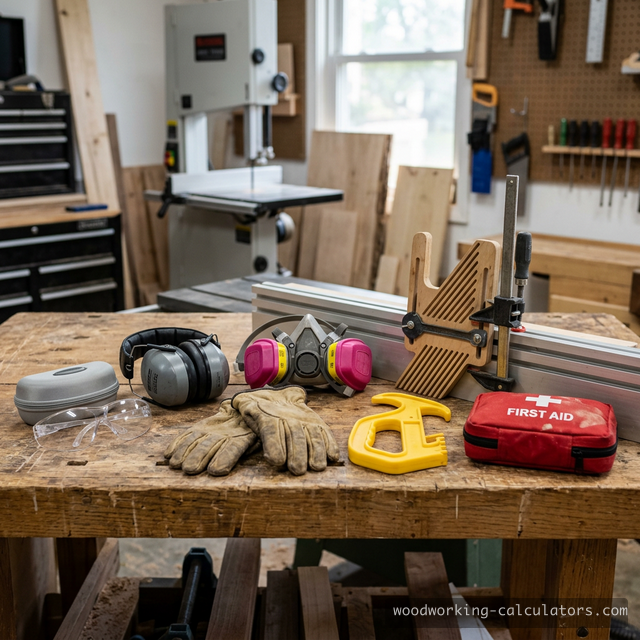
Dust Protection — The Invisible Danger
Wood dust is classified as a Group 1 carcinogen by the International Agency for Research on Cancer (IARC). Long-term exposure causes nasal cancer, respiratory disease, and asthma. This is not hypothetical — it is documented in decades of occupational health studies.
Particle Sizes That Matter
- Particles >100 microns: Visible sawdust. Caught by your nose and mouth. Nuisance but not the real danger.
- Particles 10-100 microns: Inhalable fraction. Deposited in your upper airways. Causes irritation and allergic reactions.
- Particles <10 microns (PM10): Respirable fraction. Penetrates deep into your lungs. These are invisible and stay airborne for hours. This is what harms you.
- Particles <2.5 microns (PM2.5): Ultra-fine dust from sanding and high-speed tools. Passes directly into your bloodstream through lung tissue.
Protection Strategy (Three Layers)
- Source collection: Connect a dust collector to every tool that produces chips and dust. Captures 80-90% at the source before it becomes airborne.
- Ambient filtration: A ceiling-mounted air filtration unit continuously filters airborne particles that escape source collection. Size for 3-4 air changes per hour.
- Personal protection: Wear a respirator when sanding and during operations that produce fine dust. N95 minimum; P100 half-mask respirator recommended for regular shop use.
Hearing Protection
Hearing damage is permanent and cumulative. You will not notice it happening until it is too late. OSHA limits workplace exposure to 85 dB over an 8-hour day. Most woodworking tools exceed this:
| Tool | Typical dB Level | Safe Exposure Time |
|---|---|---|
| Hand saw | 70-75 dB | Unlimited |
| Drill press | 80-85 dB | 8 hours |
| Table saw | 93-100 dB | 15-60 min |
| Router | 95-105 dB | 5-30 min |
| Planer | 100-110 dB | 2-15 min |
| Shop vac | 85-95 dB | 30-480 min |
Two protection options: foam earplugs (NRR 29-33, $0.20/pair, disposable) or earmuff-style protectors (NRR 22-30, $15-30, reusable). For maximum protection, use both together — combined NRR is roughly the higher NRR + 5 dB. Electronic earmuffs ($40-80) allow conversation while blocking impulse noise.
Eye Protection
Safety glasses must be worn for ALL powered operations, no exceptions. A wood chip from a table saw reaches your eye at 100+ mph. Standard requirements:
- Safety glasses (ANSI Z87.1): Minimum protection for all power tool use. Must have side shields. Cost: $5-15.
- Face shield: Required when turning on a lathe (a workpiece can fly off at any time) and when using an angle grinder. Wear safety glasses underneath the face shield.
- Prescription wearers: Get ANSI-rated prescription safety glasses ($30-100 online) or wear over-glasses safety eyewear. Switching to contacts specifically for shop time is dangerous — dust particles can lodge behind the lens.
Machine Safety Rules
Table Saw (Most Dangerous Workshop Tool)
- Always use the riving knife or splitter. Kickback from a table saw is the most common serious workshop injury. The riving knife prevents the wood from pinching the back of the blade and being thrown.
- Never reach over a spinning blade. Wait for the blade to stop completely before retrieving cutoffs.
- Use push sticks for rips under 6 inches wide. Your fingers should never pass within 6 inches of the blade. Push sticks cost $3 — fingers are irreplaceable.
- Never use the miter gauge and rip fence simultaneously. This traps the workpiece and guarantees kickback.
Router
- Feed direction matters. Handheld routers move left-to-right on the front edge (climb-cutting is dangerous). Router tables feed right-to-left (opposite).
- Take shallow passes. Removing more than 1/8 inch per pass risks grabbing. Deep profiles require multiple passes.
Fire Prevention
- Fine dust is explosive. An airborne concentration of wood dust at 40 grams per cubic meter can explode with a spark. This sounds unlikely, but dust collector filters and enclosed ductwork can reach these concentrations. Ground your duct collector system, empty collection bags regularly.
- Oily rags combust spontaneously. Linseed oil, tung oil, and Danish oil generate heat as they cure. A balled-up rag with curing oil can ignite in hours. Always spread used rags flat outdoors to dry or store in a metal water-filled container.
- Keep a fire extinguisher within 10 steps of your workbench. ABC-rated, 5-pound minimum. Check the gauge monthly. Know how to use it BEFORE you need it.
First Aid Preparation
A well-stocked first-aid kit should be mounted on the wall within arm's reach of the main work area. Stock it specifically for woodworking injuries:
- Pressure bandages and sterile gauze (laceration control)
- Tourniquet (for severe cuts — know how to use it)
- Eye wash station or bottle (wood chips, dust, finish splashes)
- Burn cream (router friction burns, finish fumes)
- Splinter removal tweezers and magnifying glass
- Emergency number posted on the wall
The most important rule: If you feel tired, frustrated, or rushed — stop and leave the shop. The majority of serious workshop accidents happen when the woodworker is fatigued, distracted, or hurrying to finish "just one more cut."
Recommended Calculators
Dust Collection Calculator
Size your dust collection system by CFM requirements at each tool station. Proper collection is your first line of defense.
Workshop Layout Calculator
Plan tool placement with safety clearances. Proper spacing prevents reaching over running machines.
Workshop Lighting Calculator
Inadequate lighting causes misalignment that leads to kickback and binding. 50-75 foot-candles prevents these situations.
Wood Finish Calculator
Calculate finish quantities so you buy only what you need. Less leftover finish means fewer combustible materials stored in the shop.