Woodworking Workshop Setup Guide
Design a workshop where every tool has room to work, every circuit handles the load, and every surface gets proper light — plan it right before moving the first machine
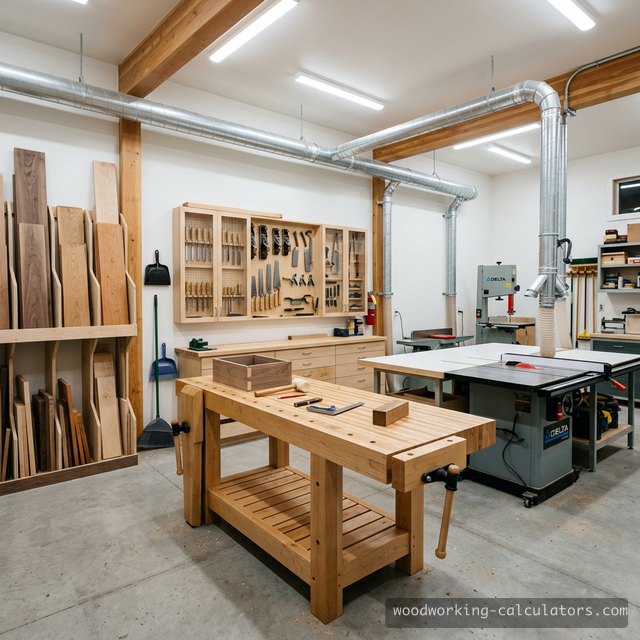
Planning Workflow
Follow these steps with the right calculators at each stage
Plan Your Floor Layout
Your floor plan determines whether the workshop is a joy or a frustration to work in. Start by measuring your available footprint and subtracting non-negotiable zones: entry doors (keep 36 inches clear), electrical panels (30 inches of clearance required by code), water heaters and furnaces if in a garage. Then position your major tools with proper clearance: a table saw needs 8 feet of clear space on infeed and outfeed sides (plus 4 feet on each side for ripping wide sheet goods), a planer and jointer each need 6 feet on both sides, and a bandsaw needs 3-4 feet in front. Position tools to share clearance zones where possible — place your table saw outfeed toward the planer infeed to share that 8-foot runway. Our layout calculator helps you visualize these zones.
Plan Electrical Circuits
Woodworking tools draw serious current, and tripping breakers mid-cut is dangerous and damages motors. Know your loads: a contractor table saw draws 13-15 amps at 120V, a 13-inch planer draws 15A, a dust collector draws 10-14A, a router draws 11-15A, and a shop vac draws 8-12A. You cannot run a table saw and planer on the same 20A circuit. Plan for minimum 3 dedicated 20A circuits: one for the primary saw station, one for the planer/jointer station, and one for dust collection. Add a 4th circuit for outlets serving routers, sanders, and smaller tools. If you are serious about the shop, consider 240V service for your table saw and dust collector — it halves the amperage draw, allows thinner wire runs, and provides more consistent power. All wiring must meet local code — pull permits and get inspections.
Design Dust Collection
Dust collection is the single most important system in your shop — it protects your lungs, keeps surfaces clean, and prevents explosion risk from fine dust accumulation. Start by listing CFM requirements at each tool: table saw (350-400 CFM), planer (400-500 CFM), jointer (350-400 CFM), bandsaw (350 CFM), router table (200 CFM), floor sweep (100-150 CFM). You only run one tool at a time in a one-person shop, so size your collector to handle the most demanding tool plus 25% overhead. A 1.5 HP single-stage collector delivers about 800 CFM at the inlet but drops to 400-600 CFM through 20 feet of 4-inch ductwork with two elbows. Always add a separator (cyclone or Thien baffle) before the collector to extend filter life. Budget $200-500 for a basic system, $800-2,000 for a proper ducted setup.
Size Your Workbench
Your workbench is the heart of the shop — size it wrong and every project is more difficult. For height: stand relaxed with arms at your sides and measure from the floor to the crease of your wrist — that is your ideal bench height, typically 34-36 inches for most adults. Too high causes shoulder fatigue during planing; too low causes back strain. For depth: 24 inches is minimum functional, 30 inches is ideal (you can reach the back without leaning awkwardly). For length: 5 feet is workable for small projects, 6-8 feet is ideal for furniture work. Build the top from laminated hardwood at 3-4 inches thick — this mass absorbs vibration and resists racking. A solid maple workbench top at 30x72x3.5 inches needs about 60 BF of 8/4 maple at $5-8/BF, so budget $300-480 for the top alone.
Plan Lighting
Proper lighting is the most underrated shop upgrade. You need 50-75 foot-candles at bench height for accurate work — most garages and basements have 10-20 foot-candles from stock fixtures, which is barely enough to see pencil lines. Calculate fixtures by space: a 20x20 foot shop (400 sq ft) needs approximately 8 four-foot LED shop lights at 4,000-5,000 lumens each, mounted at 8-foot ceiling height. Mount lights between your workstations, not directly above them, to minimize shadows cast by your body. Add task lighting at the table saw fence, drill press table, and workbench with adjustable LED work lights. Use 5,000K color temperature (daylight) for accurate wood color assessment — warm light makes cherry and walnut colors unreliable.
All Related Calculators
Workshop Layout Calculator
Plan your shop floor layout with tool footprints and clearance zones. Visualize infeed/outfeed paths and identify shared clearance opportunities.
Workshop Lighting Calculator
Calculate the number and placement of LED shop lights for shadow-free working conditions. Target 50-75 foot-candles at bench height.
Dust Collection Calculator
Size your dust collection system by calculating CFM requirements at each tool station. Includes duct sizing, static pressure losses through elbows, and collector HP recommendations.
Workbench Calculator
Calculate optimal workbench dimensions based on your height and work style. Includes material estimation for laminated hardwood tops.
Board Feet Calculator
Calculate lumber for workbench tops, tool stands, and shop furniture. A solid workbench top needs 50-70 BF of hardwood.
Glue Consumption Calculator
Calculate glue for workbench top lamination — the largest glue-up most woodworkers ever face. Plan for sufficient open time and clamp coverage.
Shelf Span Calculator
Design workshop storage shelving strong enough for heavy tool cases, lumber stacks, and hardware bins. Shop shelves carry far more weight than household shelves.
Project Total Cost Calculator
Budget your entire shop setup: workbench materials, lighting fixtures, electrical supplies, dust collection components, and storage systems.
Need More Tools?
Browse our complete collection of 55+ professional woodworking calculators